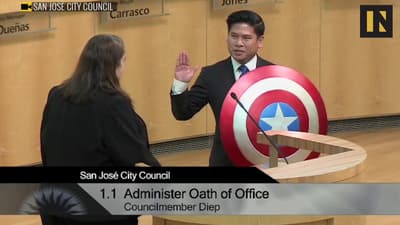
In the quiet, structured world of American civic ritual, there are certain rhythms we have come to expect. You walk into a municipal chamber, the air heavy with the scent of old wood and bureaucracy, and a local official steps forward to take their oath. There is a book—usually a Bible, sometimes a legal text—and a solemnity that suggests participation in something much older and more profound than the current political cycle. It is a moment designed to anchor the individual to a higher authority, be it divine or constitutional.
But in a small corner of California, that rhythm was broken. The expected weight of leather-bound scripture was replaced by something else: vibranium-colored steel, a circular disc, and a star. When Lan Diep stepped forward to be sworn in as a city councilman, he didn't reach for a holy book. He reached for Captain America’s shield[1].
The Symbolism of the Shield
To the casual observer, it might look like a moment of pure pop-culture whimsy—a bit of geeky flair brought into the dry arena of local government. But in the context of a swearing-in ceremony, every object carries a heavy burden of meaning. When a politician places a hand on a Bible, they are signaling a specific type of contract: one made with God, implying that their integrity is subject to a celestial witness.
By choosing the shield of Steve Rogers, the fictional first Avenger, Diep signaled a different kind of covenant. Captain America is more than a superhero; he is a symbol of an idealized American ethos—an unwavering commitment to justice, the protection of the vulnerable, and a sense of duty that transcends personal gain. For Diep, the shield wasn't merely a prop from a Marvel film; it was a shorthand for the leadership he intended to provide[1].
It is a fascinating psychological pivot. We are witnessing a shift from an era where authority is derived from ancient, religious texts to one where it is increasingly defined by shared cultural mythologies. In a secularizing society, the "hero" often fills the vacuum left by the "saint."
A New Language of Governance
The reaction to such a move is almost always split along a predictable fault line. To some, it feels irreverent—a trivialization of a sacred civic duty. There is a sense that by replacing the Bible with cinematic iconography, the gravity of the office is diminished. They see a loss of tradition, a descent into the superficiality of modern media.
But there is another way to view the gesture. We live in a time of profound cultural shifts, where the traditional markers of identity and belief are being renegotiated in real-time. For a new generation of leaders, the language of the "sacred" is changing. The symbols that resonate—the ones that actually move the needle of public perception and personal conviction—are often found in the stories we tell ourselves through film, literature, and digital media.
Diep’s gesture was a disruption of the script. It forced everyone in the room to pause and ask: What does this person actually stand for? It moved the conversation from "I swear by this book" to "I swear by these values." It was a declaration that his allegiance wasn't to a specific theology, but to the archetypal struggle of the hero fighting for the common good[1].
The Intersection of Myth and Mandate
What makes this moment so striking is how perfectly it encapsulates the tension of modern American life. We are a nation caught between the old world and the new—between the solemnity of our founding institutions and the vibrant, chaotic energy of our pop-culture landscape.
When a councilman uses a superhero's shield to take an oath, we are seeing the collision of these two worlds. It suggests that our modern myths are becoming our new moral compasses. We are looking to the characters on our screens to teach us how to be citizens, how to be brave, and how to be just. Whether that is a sign of cultural evolution or decay is a question that will likely outlast Diep's term in office, but one thing is certain: the ritual has changed, and the shield is now part of the conversation.