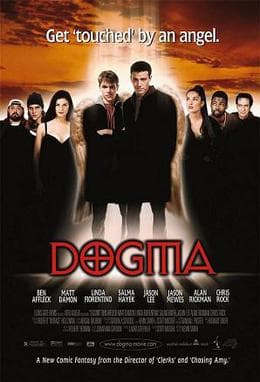
Most movies disappear gradually. They move from theaters to DVD, from DVD to streaming, from streaming to the half-remembered corner of a menu you scroll past at 1:00 a.m. Dogma did something stranger. It became famous, controversial, packed with stars, deeply tied to Kevin Smith's career, and then somehow ended up in a kind of modern excommunication. Not banned, not destroyed, just absent.
For years, if you wanted to watch Kevin Smith's 1999 religious fantasy comedy legally, you ran into an oddly old-fashioned problem. It was not available to stream. It was not available to buy digitally. Physical editions had gone out of print. A film built around loopholes in Catholic doctrine ended up trapped by a far more mundane doctrine: distribution rights.[1]
That is part of what makes Dogma such a peculiar artifact. This was not some forgotten indie that vanished before anyone noticed. It was the fourth film in Smith's View Askewniverse, starring Ben Affleck, Matt Damon, Linda Fiorentino, Chris Rock, Salma Hayek, Alan Rickman, Alanis Morissette, Jason Lee, George Carlin, Jason Mewes, and Smith himself.[1] It was noisy, ambitious, and unmistakably a Kevin Smith film. And then it became hard to see at all.
The Movie That Was Built to Cause Trouble
Dogma was almost designed to become a lightning rod. Its plot follows two fallen angels, played by Affleck and Damon, who discover a loophole in Catholic dogma that could let them re-enter Heaven, an act that would also unmake existence itself.[1] That premise allowed Smith to turn theology into comedy, apocalypse into banter, and organized religion into something both sincerely engaged with and relentlessly mocked.
The result was controversy almost on contact. The film drew protests from Catholic groups even before many of the protesters had seen it. Smith himself famously joined one protest outside a theater holding a sign that denounced the movie, a prank made even better by the fact that the people around him did not recognize the writer-director they were protesting with.[1]
That episode tells you almost everything important about Dogma. It was provocative, but in a distinctly Kevin Smith way, less a blasphemous thunderbolt than a piece of smart, talky irreverence. The movie was controversial enough to become a cultural event, but playful enough that its afterlife should have been obvious. Of course it would live on through cable, streaming, collector discs, and late-night rediscovery.
Except it did not.
How a Well-Known Movie Fell Out of Circulation
The strange part of the Dogma story is not that it was controversial in 1999. Plenty of movies survive controversy. The strange part is that it became difficult to access in an era when access is supposed to feel effortless. Wikipedia's summary of the film's release history states the core fact plainly: the film became unavailable on streaming services, unavailable for digital purchase, and out of print on home media.[1]
That kind of disappearance feels unnatural now because modern audiences are trained to think of availability as permanent. If a movie existed, surely it must be somewhere. Surely there is a rental button. Surely there is a remastered edition. Surely a studio wants the money. Dogma became a useful reminder that none of that is guaranteed. Movies are not just art objects. They are bundles of rights, contracts, and ownership histories. If those get tangled, even a famous film can drift into legal twilight.
And Dogma had exactly the sort of history that lends itself to twilight. It was released in 1999 through Lions Gate, but the rights later became tied up with Harvey Weinstein, whose personal ownership complicated the film's re-release and broader availability.[1] That detail sounds dull until you realize it can effectively lock a major film out of the normal channels through which culture now circulates.
The Irony of Being Canonical but Hard to Watch
This is what turned Dogma into a special kind of cult object. Usually, cult films are hard to find because they were too strange, too obscure, or too commercially minor. Dogma was none of those things. It performed well, became one of Smith's signature movies, and sits squarely in the middle of a larger, well-known cinematic universe.[1]
It also has the kind of cast list that should keep a movie alive forever. Affleck and Damon before they became institutions. Alan Rickman lending the material gravity by refusing to act as though any of it were silly. Alanis Morissette as God, a casting choice that still sounds like a joke until you remember how perfectly it fits the film's tone.[1]
So the movie developed a reputation that was half critical object, half scavenger hunt. People did not just recommend Dogma. They warned you that finding it might be the hard part.
Why Its Absence Matters
There is something revealing about which movies get preserved by the system and which do not. Dogma was not lost because no one cared. It was lost, temporarily or otherwise, because the infrastructure of modern film culture does not always reward care. It rewards clean ownership. It rewards easy licensing. It rewards content that can move frictionlessly from vault to platform.
Dogma had friction. It had controversy. It had a rights situation messy enough to block the simple, obvious path. So a movie about Catholic bureaucracy, cosmic technicalities, and salvation by loophole ended up caught in an earthly loophole of its own.[1]
That is why the film's absence became part of its legend. Not just because people wanted to watch it, but because its unavailability felt absurdly out of sync with its stature. A movie this important to Kevin Smith's career, this recognizable to late-1990s movie culture, and this loaded with famous performances should not have been reduced to used discs, secondhand copies, and the memory of having once seen it on cable.
But that was the reality. Dogma became the rare notable American film whose scarcity was not aesthetic, but administrative.
A Movie Trapped by the Modern Afterlife
In the end, that may be the most fitting Dogma outcome imaginable. This is a movie obsessed with who gets into Heaven, who is shut out, and what happens when an institution controls the gate. Then, in real life, the film itself ended up standing outside the gate, waiting for permission to enter the digital afterlife everyone else took for granted.
That is why the fact sticks in people's heads. Kevin Smith's Dogma was not just a controversial 1999 comedy about angels and Catholicism. For years, it was also a conspicuously missing movie, unavailable to stream, unavailable to buy digitally, and out of print on home media, a well-known film stranded in the one era that supposedly never loses anything.[1]