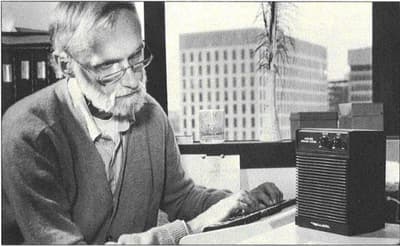
Dennis H. Klatt was born in Milwaukee, Wisconsin, on March 31, 1938, and took his first two degrees in electrical engineering at Purdue University in 1960 and 1961 [2]. He completed a Ph.D. in communication sciences at the University of Michigan in 1964, then joined the Massachusetts Institute of Technology as an assistant professor in 1965 [2]. He became a senior research scientist there in 1978 and remained on the MIT faculty until his death [2].
A 1980 paper in the Journal of the Acoustical Society of America set out Klatt's formant synthesis software, a method for generating speech sounds that researchers still use [4]. He built the complete chain from written English to audible speech, which required detailed rules for how long each speech segment should last [2]. Text-to-speech engines split that work into a front end, which normalizes text and assigns phonetic transcriptions and prosody, and a back end that converts the symbolic representation into sound [1]. Klatt's system, known as KlattTalk, handled the whole job [4].
DECtalk, the commercial product built from his research, shipped with a default male voice called Perfect Paul that was based on Klatt's own voice [2]. Joseph Perkell, a colleague at MIT through the 1970s and 1980s, said the choice was practical: "For him, the most convenient sound was the sound of his own voice" [4]. Perkell also described how Klatt worked under pressure, saying he could "function in the middle of a hurricane" [4].
Klatt built a female voice called Beautiful Betty and a child voice called Kit the Kid, the latter based on his daughter Laura [4]. Laura spoke about the project in 2013 and said her father cared most about making the output natural and intelligible [4]. The results were not flawless. The New York Times described the speech as "like a scratchy recording of a person with a lisp" [4]. Closing that gap stayed the central problem of the field long after his work [4].
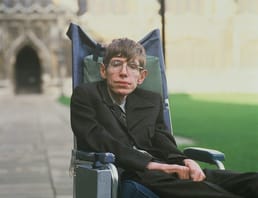
An emergency tracheotomy in 1985 left the physicist Stephen Hawking unable to speak, and for a time he spelled out words letter by letter by raising his eyebrows at a spelling card [4]. Hawking adopted a synthesizer using a voice equivalent to Perfect Paul, and that voice became one of the most recognizable in science, traced back to an MIT researcher's recordings [2][3]. When a newer system, the Speech Plus synthesizer, was offered to him in 1988, he chose to keep the Klatt-based voice [4]. He used it for books, papers and lectures, and credited the quality of the synthesizer for much of that output [4].
In 1987 the Acoustical Society of America awarded Klatt its Silver Medal in Speech Communication, and the Franklin Institute gave him the John Price Wetherill Medal for the design of a machine that can articulate written language [2]. By then he had published more than 60 scientific papers [2]. He kept a close interest in applying the work to the needs of blind and otherwise handicapped people, and KlattTalk was used by people with low vision to have computer text read aloud [2][4].
Klatt died in Cambridge, Massachusetts, on December 30, 1988, after a long struggle with cancer that also took his voice [2]. The BBC's Witness History recorded Perkell's account of the man whose recordings gave Hawking a voice, in an episode broadcast on 25 November 2019 [5]. Speech synthesis kept changing, from the Unix speak utility of 1974 to Microsoft Sam shipping with Windows 2000 [1], but the voice Hawking kept was built from Klatt's.