For Christmas in 1888, children hoping for one of Thomas Edison's talking dolls received an explanation that made the delay sound quite reasonable: the dolls were still learning to talk. His secretary, Alfred Ord Tate, sent a form letter saying they would not be ready before Easter. The explanation gave the dolls something like a childhood of their own, while women at the laboratory practiced the recitations that would make them speak.[3]
Edison had hired women to repeat nursery rhymes into small recording machines because there was no commercially viable way to duplicate the results. Stocking up on recorded voices meant keeping people at the machines. A newspaper reporter visiting in November 1888 found two women continually speaking into them while a workman produced the tiny devices. Among the surviving evidence of this work is a tin cylinder carrying an unidentified woman's rendition of "Twinkle, Twinkle, Little Star."[1]
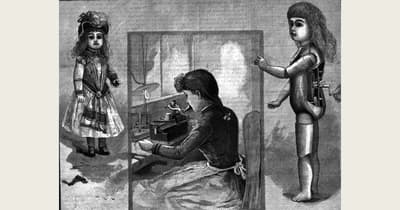
By August 1889, Edison's associate Charles Batchelor was asking the toy company for its list of verses so the voices could be trained in advance. He wanted time for the performers to practice, since the way a verse was spoken mattered to the result. By the following April, Scientific American was describing performers in individual stalls, all reciting nursery rhymes as the phonographs added their own repetitions to the noise.[2]
The dolls finally went on sale that April, with wax records replacing the earlier tin ones. Edison had tried his own voice during development, but contemporary accounts found men's voices coming out of little girl dolls comically ill-suited to the task. With women and girls supplying more suitable voices, the words still had to survive playback through the doll's small mechanism.[3]
Even before the launch, investor J. T. Spalding worried that listeners could understand the dolls only if they already knew what the toys were supposed to say. Familiar nursery rhymes gave the listener a helpful start. Keeping a hand crank moving steadily was another problem, and the miniature mechanism distorted the voice even when its record was new. A new record could sound unnatural too, particularly when the person turning the handle sped up or slowed down.[2]
Within a month of the launch, production had stopped. In 1896, the phonographs were removed from the dolls remaining in storage, and the dolls were sold without their voices.[3] An earlier tin record survived among items in the desk of Edison's secretary William H. Meadowcroft; park curators cataloged it in 1967. The cylinder had become badly bent, leaving curators unable to play it conventionally.[1]
On May 11, 2011, Carl Haber and Earl Cornell at Lawrence Berkeley National Laboratory recovered its sound by scanning the surface in three dimensions and turning that digital model into audio. Historian Patrick Feaster helped identify and date the recording to late 1888. The woman remained unidentified, but almost her whole verse could be heard: the recovery was missing only the first syllable of the first word.[1]
Sources
- Early Talking Doll Recording Discovered
- Talking Doll FAQ: Sound Recordings
- Patrick Feaster: A Cultural History of the Edison Talking Doll Record
Image: Detail of the April 26, 1890 Scientific American cover, showing a recording performer between two views of an Edison talking doll. Public domain, via Wikimedia Commons. Cropped and placed on a neutral background.