Christiaan Huygens was home in The Hague in 1665 when two clocks began behaving less like machines than roommates. He had built them himself, hung them from the same support, and watched their pendulums settle into what he called an odd sympathy. Start them differently and, given enough time, they found each other again.[1]
Two pendulum clocks mounted on the same wooden support can synchronize because each one sends tiny vibrations through the structure they share. Huygens spotted the effect in 1665, and modern researchers later rebuilt the experiment to show the hidden conversation in the wood.
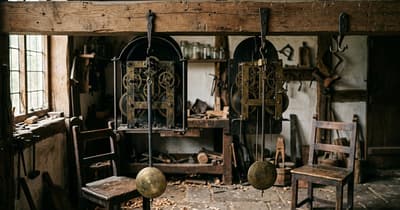
In Huygens's setup, the clocks hung from a wooden beam laid across two chairs. The pendulums did not merely tick near one another. They swung in perfect consonance, often in opposite directions, as if the beam between them had become a messenger.[2]
Huygens's letter to R. F. de Sluse on February 22, 1665, carried the strange report out of the room. Two days later, Huygens wrote about the clocks again to his father and to a member of the Royal Society in London. Differential calculus had not yet arrived to give him the modern language for coupled oscillators, but he named the likely culprit anyway: small movements in the wooden support.[2]
In Eindhoven and Mexico, three and a half centuries later, researchers built the experiment again with larger clocks, better sensors, and sharper equations. The old question stayed stubbornly domestic. What happens when two instruments, each made to keep its own time, have to lean on the same piece of furniture?[1]
The Scientific Reports clocks repeated the shared-support trick with their own massive pendulums. The pendulums could swing in consonance and in the same direction. The agreement came with a small practical insult: once synchronized, the clocks' common oscillation frequency decreased, making the clocks run slow.[2]
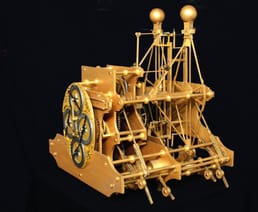
At sea, a few seconds of bad time could turn into a bad guess about where a ship was on the planet. Accurate timekeeping was tied to navigation, especially the hard problem of finding longitude. Later marine timekeepers became famous because a reliable clock could give sailors something the horizon could not.[3]
Beneath the two clock cases, the wooden beam carried more than their weight. A clock built to divide time into disciplined pieces could still be nudged by its neighbor. The wood did not shout. It flexed almost invisibly, passing small disturbances back and forth until the two machines agreed on a rhythm neither one had chosen alone.
Left on the same beam, the two brass pendulums make Huygens's phrase feel less quaint. Odd sympathy was a man noticing that accuracy can be contagious, and that time itself may be negotiated through a piece of wood.
Sources: