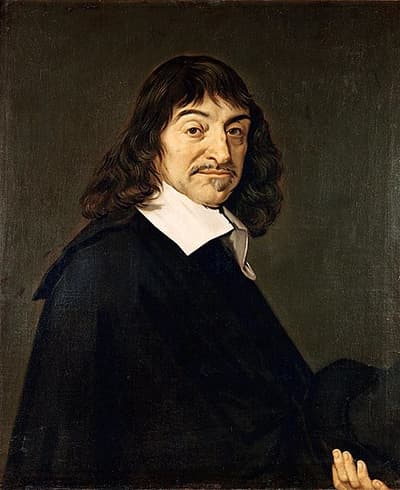
In November 1619, René Descartes was not yet the marble bust from philosophy textbooks. He was 23, in military service, moving through a Europe convulsed by war, still trying to discover what kind of mind he was going to become.[1]
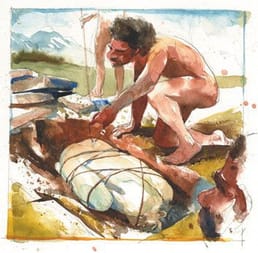
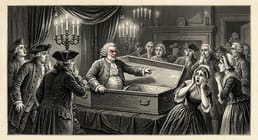
Then came one of the strangest nights in intellectual history. Stationed in Neuburg an der Donau during a bitter cold spell, Descartes shut himself inside a heated room, likely one warmed by a tile stove, to escape the weather.[1] There, on the night of 10 to 11 November, he experienced three vivid dreams, or visions, so powerful that he came to believe a divine spirit had revealed to him the outline of an entirely new philosophy.[1]
This is the part that feels almost fictional: a young mercenary, alone in a warm room, emerging with a new way to think. But according to the early biographical account by Adrien Baillet, that is essentially what Descartes believed had happened. By the time he stepped back out into the cold, he had begun formulating two ideas that would help change the modern world: analytical geometry, and the conviction that the mathematical method could be applied to philosophy itself.[1]
The Soldier Before the Philosopher
It is easy to forget how unlikely Descartes's early life looks in retrospect. He had studied at the Jesuit college of La Flèche and earned degrees in law at Poitiers, but in 1618 he joined the Dutch States Army as a mercenary officer-in-training under Maurice of Nassau.[1] He was not drifting so much as experimenting, trying on lives.
Military service also placed him close to mathematics and engineering. In Breda he studied military engineering and met Isaac Beeckman, a mathematically gifted schoolmaster who encouraged him to sharpen his scientific thinking.[1] The future philosopher of doubt was, at this stage, still assembling himself out of mechanics, geometry, war, and ambition.
That matters, because the visions of 1619 did not arrive in a vacuum. They landed in a mind already primed to connect order, number, and reality.
The Three Dreams
Baillet's later account says Descartes had three dreams that night and treated them as revelation.[1] He did not interpret them as random noise from a sleeping brain. He read them as a message, a calling, a sign that all truths were linked and that human knowledge could be reorganized from the ground up.
In Descartes's telling, the experience was not merely emotional. It was structural. He came away persuaded that science, properly pursued, was a search for true wisdom, and that this would become the central labor of his life.[1] That is the striking part. The dreams did not just inspire him. They gave him a program.
One of the dreams reportedly involved a violent noise. Modern readers, being modern readers, have looked at that detail and wondered whether something neurological might have been going on. Wikipedia notes that the second dream may have been an episode of exploding head syndrome, a harmless but startling phenomenon in which a person imagines a sudden loud sound while falling asleep or waking.[1] That does not explain the whole night, and it certainly does not explain Descartes. But it is a reminder that some of history's most consequential mystical moments may have unfolded inside very human bodies.
The Birth of a Method
What Descartes seems to have grasped in that heated room was not just a single insight, but a way of proceeding. If truths were connected, then perhaps one could begin with something fundamental and move outward by logic, the way a geometric proof unfolds from first principles.[1]
That was the seed of the Cartesian style: strip away confusion, distrust inherited authority, begin with what can be known clearly, and build. It is a style so familiar now that it is hard to recover how radical it once felt. Descartes was imagining that certainty in philosophy might be achieved the way certainty is achieved in mathematics.
And mathematics, for him, did not remain untouched. He is widely credited with helping unite algebra and geometry into what became analytical geometry, the great bridge that lets shapes become equations and equations become shapes.[1] That bridge matters more than it sounds. It helped make possible calculus, modern physics, and much of the mathematical language through which we now describe space itself.
Why the Room Matters
There is something almost symbolic about the setting. Outside: war, cold, Europe in fracture. Inside: heat, solitude, concentration. Descartes withdraws from the noise of the world and, in doing so, begins constructing a philosophy built on internal clarity.
This pattern would define him. He would go on to become one of the foundational figures of modern philosophy, famous for methodological doubt, for cogito, ergo sum, and for treating mathematics as the model of disciplined thought.[1] But the emotional origin story is older and stranger: a young man, alone at night, convinced that reality had briefly opened and shown him its architecture.
That does not mean we have to accept the dreams exactly as he did. We can hold two ideas at once. Perhaps Descartes had an intense spiritual experience. Perhaps one part of it involved a neurological event. Perhaps the dreams mattered not because they were supernatural, but because he decided they did. History is full of people who experience odd things. It is not full of people who can turn those experiences into a method.
After the Visions
In 1620, Descartes left the army.[1] Over the years that followed, he traveled, returned to France, and eventually settled for long stretches in the Dutch Republic, where he wrote the major works that made his name.[1] But he seems to have looked back on that November night as a hinge in his life, the moment when scattered talent became direction.
That is why the episode endures. Not because it proves that dreams are divine, or that philosophy begins in hallucination, or that every strange nocturnal jolt hides a revolution. It endures because it captures something true about invention. Big ideas do not always arrive in tidy, rational sequences. Sometimes they come in a rush, wrapped in fear, cold, noise, and symbolism. The rigor comes later.
Descartes emerged from that room believing that knowledge could be rebuilt on mathematical foundations.[1] Four centuries later, we are still living inside the consequences of that conviction.