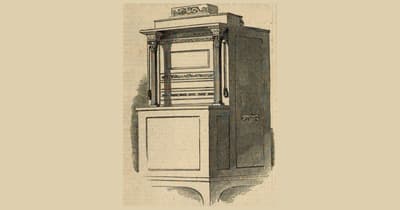
For a shilling, visitors to London's Egyptian Hall could watch a wooden cabinet write Latin verse. John Clark brought his machine, Eureka, to Piccadilly in 1845, complete with musical accompaniment: as letters appeared in its little windows, a cylinder inside played the national anthem. When the line was ready, the music stopped and the audience could inspect what their mechanical poet had come up with.[1][2]
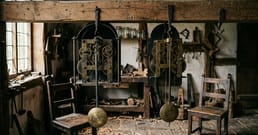
Back in Somerset, Clark had worked as a grocer and printer and learned to repair clocks, a useful preparation for the years he spent building Eureka. He wanted it to produce hexameter, the verse form used in classical epic, without a human author choosing each new line. The public performance therefore depended on decisions he had made long before anyone bought a ticket, beginning with the words he allowed his machine to use.[1]
Inside the cabinet, six drums carried wires of different lengths, onto which strips of wood bearing letters descended. Each strip stopped at the height needed to display a particular letter. As the drums turned to new positions, the wires arranged fresh combinations from Clark's chosen vocabulary, keeping the words in a fixed grammatical order. Visitors watched the letters settle into place; Clark had already done the patient work of deciding which words could meet.[1]
At roughly a line a minute, Eureka gave its audience time to copy the result before an audible warning announced that it was about to disappear. The Illustrated London News described the letters slowly returning to their starting positions, accompanied by another tune. Above the display, an inscription urged people to transcribe the lines as they appeared. Taking a poem home required keeping up with a cabinet that was preparing to take it apart.[2]
When the educational reformer William Ballantyne Hodgson visited, he found faults in both the meaning and the meter. His account put Clark's labor at fifteen years, more time, he remarked, than a school needed to make a boy into a verse-making machine. The joke had a practical setting: boys at elite English schools were expected to compose Latin verse. Eureka could perform a version of their assignment in front of paying spectators, while still attracting complaints about the quality of the work.[1]
At Clark's house in Eastover, his great-niece remembered a smaller transaction. He let her put a penny into the machine and watch the verse appear. According to curator Karina Virahsawmy, this was long treated as a story told to amuse children, until conservation work uncovered both a coin slot and a receptacle. The family recollection had preserved a detail that might otherwise have been missed.[3]
The conservators were working through a cabinet that had been altered over the years, finding replacement wooden ornaments and traces of its formerly gilded front. They also examined how the coin arrangement worked, which qualified the great-niece's recollection without dismissing it. A penny could indeed go into Eureka, but it did nothing to start the mechanism. The money collected inside while the machine waited for its operator.[3]
Sources
- Mike Sharples, John Clark's Latin Verse Machine: 19th Century Computational Creativity (2023)
- The Illustrated London News, July 19, 1845, transcribed by Cora Angier Sowa
- Karina Virahsawmy, Eureka, Poetry by Numbers, University of Exeter
Image: Eureka in The Illustrated London News, July 19, 1845, p. 37. Anonymous engraving, public domain, via Wikimedia Commons. Presented on a paper-tone background.