
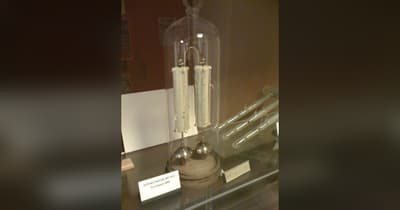
In 1825, London instrument makers Watkins and Hill built a small electric battery and told the Reverend Robert Walker, a clergyman and physicist at the University of Oxford, that it would last "three or four years."[1] The battery has been ringing a bell since 1840. Nobody knows what's inside.
A battery made from layers of tin foil and paper has been ringing a bell at Oxford University for over 185 years, producing more than 10 billion rings. Nobody knows what the battery is made of, and nobody wants to open it to find out.
The device sits in a corridor at the Clarendon Laboratory, behind two layers of glass. Two brass bells hang beneath a pair of dry pile batteries, an early type of battery made from thin layers of metal foil separated by paper. A metal sphere, about four millimeters in diameter, hangs between the bells. When the sphere touches one bell, it picks up an electric charge and is repelled toward the other. The charge reverses, and the process repeats. The sphere strikes each bell twice a second.[2]
Watkins and Hill built the battery on the design of Giuseppe Zamboni, an Italian physicist and Catholic priest who had published his method for making dry piles in 1812.[3] Zamboni's piles used discs of paper coated with zinc foil on one side and manganese dioxide on the other. They produced high voltage but almost no current: about one nanoamp, a thousand times less than a wristwatch uses.[1] That tiny drain is why the battery has lasted so long.
Nobody can say for certain what Watkins and Hill actually put inside. There is no surviving documentation that lists the exact materials, the number of layers, or the specific construction. Zamboni used tin foil. Other designs of the time used zinc, sulfur, or silver. The Oxford Electric Bell has outlasted every other known dry pile battery from the same era by a wide margin, and the reason is unknown.[1]
A physicist could open the battery and read its contents like a book. Nobody has. Cracking the dry piles would end the longest-running electrical experiment in history, and nobody wants to be the person who stopped the bell.[1]
The battery has slowed down in recent decades. It may run out in a few years, or it may ring for decades more. Walker's grandson verified the handwritten notice that reads "Set up in 1840."[2] The Guinness Book of World Records lists it as "the world's most durable battery."[2]
The clapper is still swinging. It hits one bell, then the other, twice a second, behind two layers of glass in a corridor at the Clarendon Laboratory. It has done this more than 10 billion times. It is still going.