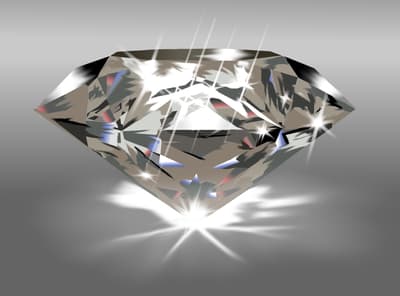
A diamond ring and a pencil look like opposites until you strip away the romance and the yellow paint. The stone in the ring and the dark line from the pencil are both carbon. The difference is architecture: the same atoms, locked into different arrangements.
Diamonds slowly tend toward graphite because graphite is the lower-energy form of carbon at normal temperature and pressure. The change is real, but under everyday conditions it is so slow that a diamond can last millions to billions of years.
In a diamond, each carbon atom bonds to four neighboring carbon atoms in a tightly packed three-dimensional lattice. In graphite, each carbon atom bonds strongly to three neighbors in flat sheets, while those sheets cling only loosely to one another.[1] That layered structure is why graphite can smear across paper. A pencil mark is carbon coming off in tiny sheets.
Under ordinary conditions, graphite is the more stable arrangement. Dr. Christopher S. Baird, a physicist at West Texas A&M University, explains that diamonds degrade to graphite because graphite is a lower-energy configuration under typical conditions.[1] No outside chemical ingredient has to attack the stone. The carbon atoms would need to rearrange internally, breaking some bonds and forming others.
The Wall Between Sparkle and Graphite
A diamond does not casually collapse into graphite because its atoms are trapped behind a large energy barrier. Baird compares the situation to standing in a shallow hole beside a deeper hole, with a wall between them. The deeper hole is the more stable place to be, but you cannot get there unless you first gain enough energy to climb the wall.[1]
Chemists call diamond metastable. It is not the lowest-energy form of carbon at normal temperature and pressure, yet it can remain stuck in its present structure for an extraordinary length of time.[1] Thermodynamics favors graphite. Kinetics, the part of chemistry concerned with how fast changes happen, keeps the diamond from visibly changing on a human schedule.
At comfortable room temperatures, away from intense ion bombardment and extreme heat, the conversion from diamond to graphite is so slow as to be practically nonexistent.[1] Baird writes that a diamond worn on a finger under normal human conditions can last millions to billions of years, making “diamonds are forever” a very good approximation for everyday life.[1]
Some estimates stretch the timescale even further. At room temperature, a cubic centimeter of diamond has been described as taking vastly longer than the age of the universe to fully convert into graphite; at very high temperatures, the process can become much more noticeable.[3] A person waiting for a wedding ring to become pencil graphite is making a bet no human life can collect.
How to Hurry a Diamond
Heat gives carbon atoms energy. Baird notes that heating diamond or bombarding it with ions can give the atoms enough energy to cross the barrier and reconfigure toward graphite.[1] A different kind of destruction is possible too. In oxygen at high temperatures, diamonds can burn into carbon dioxide rather than become graphite.[2]
Pressure pushes carbon in the other direction. Diamonds are favored under high pressure, which is part of why they form deep inside Earth rather than on a desktop.[2] Many natural gem-quality diamonds are ancient, often dated between about 1 and 3.3 billion years old.[2] They survive because once carbon takes the diamond structure, that structure is extraordinarily hard to undo.
The old slogan is physically wrong and practically useful. Diamonds are not eternal in the strict sense. They are carbon caught in a brilliant, stubborn arrangement, leaning almost imperceptibly toward the dull gray stability of graphite. On a finger, the stone keeps shining. At the scale where matter searches for its lowest-energy home, the pencil was waiting all along.