In 1867, William Thomson, later known as Lord Kelvin, saw smoke rings and pictured the universe tied in loops. Scottish physicist Peter Tait had been experimenting with the rings, and Thomson drew a grand conclusion from them: atoms might be knots of swirling vortices in the ether, with different elements corresponding to different knots and links.[3]
Since knot theory took shape in the 19th century, mathematicians have tabulated more than six billion knots and links. The count comes from treating a knot not as a loose shoelace, but as a closed loop whose tangled shape can be classified.
Kelvin’s atom theory eventually fell away, but the bookkeeping problem survived it. If sodium and gold were not tiny vortex knots, the question underneath the mistake still had teeth: how many genuinely different ways can a loop be tangled?
A mathematical knot is stricter than the one in a shoelace. A shoelace has ends, so it can be untied. In knot theory, the ends are joined, making a closed loop. The simplest case is a plain ring, called the unknot. A more interesting knot is a loop that cannot be smoothed back into that ring without cutting it or passing it through itself.[2]
The Catalog That Outgrew Intuition
On paper, the first task looks almost like a puzzle. Draw one tangle. Draw another. Decide whether they are truly different, or whether one is only a stretched, twisted, or rotated version of the other. Knot theorists call two knots equivalent when one can be transformed into the other by deforming space around it, without cutting the loop or forcing it through itself.[2]
A single knot can also appear in many diagrams. Two drawings that look unrelated may describe the same closed loop, which makes classification harder than simple visual sorting. Mathematicians use knot invariants, quantities that stay the same across different descriptions, to help tell knots apart. Important examples include knot polynomials, knot groups, and hyperbolic invariants.[4]
The early founders of knot theory wanted tables of knots and links, with links meaning several knotted components entangled with one another. Since the beginnings of knot theory in the 19th century, more than six billion knots and links have been tabulated.[4] The familiar overhand knot in the hand becomes almost misleading at that scale, a small household gesture opening onto an enormous mathematical census.
Long before those tables, people had tied knots for fastening, recording information, climbing, sailing, decoration, and religious symbolism. The endless knot appears in Tibetan Buddhism, and the Book of Kells contains intricate Celtic knotwork.[3] Mathematics did not invent the human fascination with knots. It gave that fascination a counting problem.
When Chemists Started Tying Molecules
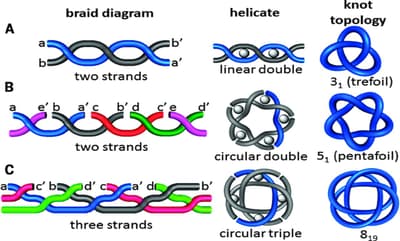
In 1989, chemist Jean-Pierre Sauvage created the first synthetic chemical knot, a trefoil, whose strands cross at exactly three points. Sauvage later shared the 2016 Nobel Prize in Chemistry for work on molecular machines.[1] A shape from knot theory had been made from molecules.
For years afterward, the chemical side lagged far behind the mathematical one. David Leigh of the University of Manchester later said that, for the next 25 years, chemists could not make knots more complicated than that first synthetic class.[1] The tables kept growing, while the laboratory could reach only a few of the simplest forms.
Leigh’s team later produced what the Journal of Young Investigators described in 2017 as the tightest knot ever created. Published in Science, the Manchester chemists used synthetic chemistry to braid molecular strands into a structure with more than eight crossings.[1] The knot was also described as a type of molecular machine, part of a path toward machinery operating at molecular scale.[1]
That leaves the subject balanced between two kinds of smallness: a table with more than six billion entries, and a molecular strand coaxed into crossing the right way. Kelvin’s smoke rings are gone, but the loop remains, closed on itself, waiting to be counted.