In the middle of the Cold War, the United States asked a question so unsettling it sounded less like research and more like a dare: Could a country build a nuclear bomb using only unclassified information?[1]
So in 1964, at Lawrence Radiation Laboratory, they ran a test. Not with veteran bomb designers. Not with a secret Manhattan Project reunion. They handed the problem to three young physicists who had only recently earned their PhDs, men with little to no direct experience in nuclear weapons design, and told them to see how far open literature alone could take them.[1]
The project became known as the Nth Country Experiment, and its premise was as chilling as it was simple. If a handful of smart outsiders could sketch a credible bomb design from public sources, then the barrier to nuclear weapons was lower than many officials wanted to believe. And if that was true in 1964, in an era of card catalogs and library stacks, the implications for nuclear proliferation were enormous.[1]
A Thought Experiment With Real Consequences
The phrase “Nth country” meant the next country, the unknown one, the state that did not yet have the bomb but might someday want it. That was the fear. Not just the Soviet Union or China, but the country after that, and the one after that. Could the bomb spread not because secrets were stolen, but because science had already traveled far enough on its own?[1]
The laboratory wanted to know whether “a few capable physicists,” armed only with unclassified material, could produce a plausible weapon design with a militarily significant yield.[1] That wording matters. The experiment was not asking whether amateurs could casually assemble something catastrophic in a garage. It was asking something more strategic, and in its own way more alarming: whether the basic intellectual puzzle had already escaped containment.
The Library Was the Laboratory
What the physicists discovered first was not a secret formula. It was that much of the background knowledge was already out there. By the 1960s, the basic science of nuclear fission was no longer locked behind a wall. Programs like Atoms for Peace had encouraged the global spread of nuclear knowledge for civilian purposes, especially around energy. But that was the paradox at the center of the atomic age: the knowledge needed to light cities and the knowledge needed to threaten them were never entirely separable.[1]
One of the participants later described the process with almost unnerving casualness. You went to the library. You looked under plutonium, uranium, high explosives, nuclear physics. You kept digging. You followed references. You found articles, books, technical publications. Slowly, a picture emerged.[1]
That is what made the experiment so historically significant. It suggested that the hardest part of the nuclear problem might not be knowing what a bomb is in theory. It might be everything that comes after.
What They Actually Proved
After roughly three years, the team completed its work. One of the original three left early and was replaced, but the project reached its endpoint: a serious design study produced from open sources by physicists who had not entered the room as weapons experts.[1]
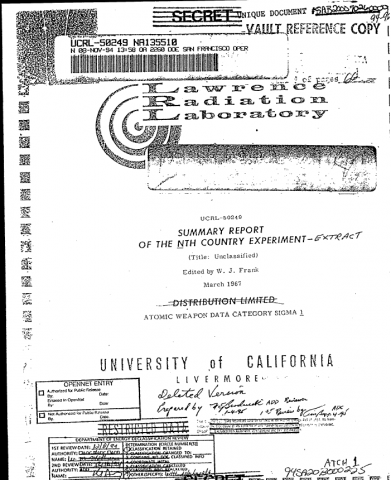
That did not mean they had built a bomb. It did not even mean every expert agreed their design would have worked exactly as they hoped. In fact, that is where the story gets more interesting. The final results were classified by the Atomic Energy Commission, even though the team had relied on unclassified sources. The document that survives is heavily redacted. Later critiques attached to the report questioned how confident anyone should be about the projected performance of the design.[1]
In other words, the experiment did not produce a neat Hollywood ending. It produced something messier and more realistic: a demonstration that public information could take you disturbingly far, paired with a reminder that paper designs and real-world weapons are not the same thing.[1]
The Real Bottleneck Was Never Just Knowledge
This is the crucial distinction. The Nth Country Experiment was never really about whether a smart physicist could understand the theory. It was about whether a nation could cross the much larger gulf between theory and deployment.
Because a nuclear weapon is not just an idea. It is an industrial achievement. It requires rare materials, large facilities, specialized processing, money, engineering discipline, and the ability to solve problems that do not announce themselves in advance. The experiment's own conclusions pointed toward those practical barriers. Getting the necessary fissile material and the infrastructure to produce or process it would be a monumental undertaking for any would-be nuclear state.[1]
That is what makes the story so durable. It did not reveal that nuclear weapons were “easy.” They are not. What it revealed is that the world had already passed a more subtle threshold: the age when the hardest thing to control was no longer the equation on the chalkboard, but the machinery, materials, and organization needed to turn that equation into reality.
Why Historians Still Talk About It
The Nth Country Experiment still gets invoked whenever people argue about proliferation or nuclear terrorism. Some point to it as proof that the knowledge barrier has been low for decades. Others argue that it proves almost the opposite, that knowing the outline of a weapon is not the same as being able to produce one that works.[1]
Both readings contain something true. The experiment showed that secrecy has limits. By the 1960s, nuclear science had become too widely distributed to be locked back up. But it also showed that technological capability is more than information. There is a vast difference between understanding a system and commanding all the material and industrial steps required to make it real.
That may be the experiment's real legacy. It did not settle the nuclear question once and for all. It made the question impossible to ignore. In a world where advanced knowledge keeps leaking outward, where civilian and military technologies often overlap, and where the next proliferator may not look like the last one, that is no small thing.[1]
Three young physicists were asked to answer a nightmare in the form of an assignment. They spent years doing it. And what they found was not comfort. It was a warning.[1]
Sources
[1] Atomic Heritage Foundation / Nuclear Museum: Nth Country Experiment