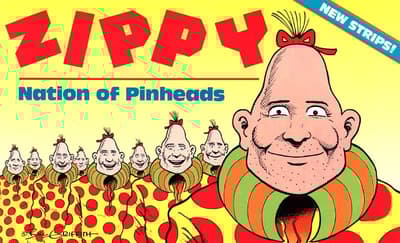
, , Bill Griffith is the creator of the iconic ‘Zippy the Pinhead’ and an American underground comix movement member. Born William Henry Jackson Griffith, he attempted to become the “next big thing” in New York’s art world, but in 1967 he realized the “art thing” wasn’t going to work out. So, in 1969, he began drawing comics for various underground comic publications. Do you know Who Inspired the Characters in Bill Griffith’s Comics? Bill Griffith ist der Schöpfer des ikonischen ‘Zippy the Pinhead’ und ein Mitglied der amerikanischen Underground‑Comix‑Bewegung. Geboren als William Henry Jackson Griffith, versuchte er, das “nächste große Ding” in der New Yorker Kunstszene zu werden, doch 1967 erkannte er, dass das “Kunstding” nicht funktionieren würde. Also begann er 1969, Comics für verschiedene Underground‑Comic‑Publikationen zu zeichnen. Weißt du, wer die Figuren in Bill Griffith’s Comics inspiriert hat? William Henry Johnson influenced Bill Griffith’s comic book character Zippy the Pinhead. Johnson was born with an unusually tapering cranium, leading some to believe he was a microcephalic. Johnson used to work for P.T. Zip the Pinhead a character created by P.T. Barnum. William Henry Johnson beeinflusste Bill Griffith’s Comicfigur Zippy the Pinhead. Johnson wurde mit einem ungewöhnlich spitz zulaufenden Schädel geboren, was einige glauben ließ, er sei mikrozerebrisch. Johnson arbeitete früher für P.T. Zip the Pinhead, eine von P.T. Barnum geschaffene Figur. His first strips were published in New York City’s East Village Other and Screw Magazine and featured an angry amphibian named ‘Mr. ‘The Toad.’ Seine ersten Strips wurden im New York City’s East Village Other und im Screw Magazine veröffentlicht und stellten einen wütenden Amphibien namens ‘Mr. ‘The Toad.’ vor. Beginning with his romance comics parodies Tales of Toad and ‘Young Lust,’ he became a part of the San Francisco underground comix movement in 1970. He has worked with most indie publishers from the 1970s to the present, including Print Mint, Last Gasp, Rip Off Press, Kitchen Sink, and Fantagraphics Books, and has published work in Yellow Dog and Real Pulp. (Source: Inkct) Beginnend mit seinen Parodien von Liebescomics wie Tales of Toad und ‘Young Lust,’ wurde er 1970 Teil der San Francisco Underground‑Comix‑Bewegung. Er hat mit den meisten Indie‑Verlagen von den 1970er Jahren bis heute zusammengearbeitet, darunter Print Mint, Last Gasp, Rip Off Press, Kitchen Sink und Fantagraphics Books, und hat Arbeiten in Yellow Dog und Real Pulp veröffentlicht. (Quelle: Inkct) His most well-known creation is ‘Zippy the Pinhead’ (as in ‘Zippy for President’), a polka-dotted clown suit-wearing human with a pointy head who first appeared in the first issue of Real Pulp in 1970. Griffith’s aesthetic was distinct from that of other underground artists. His satirical and humorous comics openly criticize today’s media-saturated and celebrity-obsessed society. The strip first appeared weekly in the Berkeley Barb in 1976. It was then syndicated nationally by Rip Off Press until the artist switched to self-syndication to college newspapers and alternative weeklies under the Zipsend (later Pinhead Productions) label in 1980. Seine bekannteste Schöpfung ist ‘Zippy the Pinhead’ (wie in ‘Zippy for President’), ein mit Polka‑Punkten versehener Clownanzug tragender Mensch mit spitzem Kopf, der erstmals 1970 in der ersten Ausgabe von Real Pulp erschien. Griffith’s Ästhetik unterschied sich von der anderer Underground‑Künstler. Seine satirischen und humorvollen Comics kritisieren offen die heutige mediengesättigte und promi‑verrückte Gesellschaft. Der Strip erschien erstmals wöchentlich im Berkeley Barb im Jahr 1976. Danach wurde er national von Rip Off Press verbreitet, bis der Künstler 1980 zur Selbstvermarktung an Uniszeitungen und alternative Wochenblätter unter dem Label Zipsend (später Pinhead Productions) wechselte. ‘Zippy’ has also been featured in National Lampoon, High Times, Arcade, Yow, Weirdo, and the San Francisco Examiner. Since 1990, King Features Syndicate has delivered the comic to a national audience daily in over 200 newspapers. Zippy’s catchphrase, “Are we having fun yet?” has become a well-known national catchphrase. Bill Griffith, who lives and works in East Haddam, Connecticut, with his wife, cartoonist Diane Noomin, has also contributed to The New Yorker irregularly since 1994. His work has been reprinted in several languages, including German, French, Swedish, Italian, Japanese, Dutch, Finnish, and Spanish. ‘Zippy’ wurde auch in National Lampoon, High Times, Arcade, Yow, Weirdo und dem San Francisco Examiner veröffentlicht. Seit 1990 liefert King Features Syndicate den Comic täglich an ein nationales Publikum in über 200 Zeitungen. Zippy’s Spruch, “Are we having fun yet?” ist zu einem bekannten nationalen Schlagwort geworden. Bill Griffith, der mit seiner Frau, der Karikaturistin Diane Noomin, in East Haddam, Connecticut, lebt und arbeitet, hat seit 1994 unregelmäßig für The New Yorker beigetragen. Seine Arbeiten wurden in mehreren Sprachen nachgedruckt, darunter Deutsch, Französisch, Schwedisch, Italienisch, Japanisch, Niederländisch, Finnisch und Spanisch. Griffith illustrierte ‘ProJunior’ (Kitchen Sink Press, 1971), ein Einzelausgabe-Comicbuch, das auf Don Dohlers Figur ProJunior basiert. In Monte Beauchamps Buch ‘The Life and Times of R. Crumb’ schrieb er ein persönliches Hommage an Crumb. Crumb. Kommentare von Zeitgenossen (New York: St. Martin’s Griffin, 1998). Zippy ist auf T‑Shirts für Hunde und Menschen, Tassen, Postern, Briefmarken, Aufklebern für Autos, Schürzen, Aufklebern, Schlüsselanhängern, Puppen, Tragetaschen, Magneten, Krawatten, Hüten, Skateboards, Karten, Kalendern und Schuhen verewigt, wobei Griffith alles selbst über Zazzle.com abwickelt. „Ich mochte das Z“, sagte Griffith über Zazzle, das er entdeckte, als er nach einem Ort suchte, um seine „Zippy“-Souvenirs zu verkaufen. Zippy hatte im Laufe der Jahre mehrere Möglichkeiten, in Hollywood zu arbeiten, hat jedoch Angebote von Showtime, Disney, NBC Films und George Harrisons Firma HandMade Films abgelehnt. (Quelle: Inkct) etc. Also keep link unchanged.
Now produce final HTML with translated content.
Check for any stray apostrophes: Keep original HTML entities. For example, ‘ and ’ are left and right single quotes. Should we keep them? They appear in original text. We can keep them as is. But we replaced some with plain quotes. Might be okay. But to preserve original, maybe keep them. However translation may need to keep them. Let's keep them as they are in original where they appear. For example, first paragraph uses ‘Zippy the Pinhead’. We'll keep that. Also other quotes like “ etc. We can keep them. So we need to replace English text but keep entities.
Thus we need to keep the entities exactly. For example, first paragraph: "Bill Griffith is the creator of the iconic ‘Zippy the Pinhead’ and an American underground comix movement member." We'll translate but keep ‘Zippy the Pinhead’ unchanged. So: "Bill Griffith ist der Schöpfer des ikonischen ‘Zippy the Pinhead’ und ein Mitglied der amerikanischen Underground‑Comix‑Bewegung."
Similarly for other entities.
Let's rewrite each paragraph preserving entities.
Paragraph 1 original:
Bill Griffith’s Early Works
Translate to German: "Bill Griffiths frühe Werke". Keep entity for apostrophe? The original has ’ after Griffith. We'll replace with "Bill Griffith’s Early Works" -> "Bill Griffith’s Early Works"? Actually we need German text, but keep entity for apostrophe after Griffith? Could use "Bill Griffith’s Early Works" but replace with German. So: "Bill Griffith’s Early Works" becomes "Bill Griffith’s Early Works"? No. Should be "Bill Griffith’s Early Works" replaced with "Bill Griffith’s Early Works"? That doesn't make sense. Better to write "Bill Griffith’s Early Works" -> "Bill Griffith’s Early Works"? Hmm.
We can keep the entity for the apostrophe but change surrounding text: "Bill Griffith’s Early Works" -> "Bill Griffith’s Early Works"? Actually we need "Bill Griffiths frühe Werke". To keep apostrophe entity, we could write "Bill Griffith’s frühe Werke". That would be weird but acceptable. Use entity for apostrophe after Griffith. So:
Bill Griffith’s frühe Werke
Next paragraph:
Bill Griffith and Zippy the Pinhead
Translate: "Bill Griffith und Zippy the Pinhead". Keep entity? No apostrophe. So:
Bill Griffith und Zippy the Pinhead
Next paragraph: