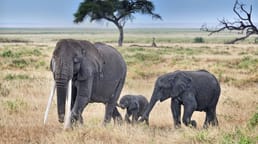

African elephant calves spend about 90 percent of their time within five metres of another elephant [1]. Calves depend on their mothers and other family members for survival, social support and learning through their first four to five years, and the closeness lasts: male elephants typically leave the group in late adolescence, while females often remain with it [1].
A mother elephant introduces her newborn to each member of the group, and each one greets the calf with gentle touches from its trunk, soft humming and reassuring rumbles [3]. Herd members then keep stepping in to provide care, and the strongest bonds in the herd are between mothers and their offspring [3].
Protector elephants chase predators away from calves, stop aggressive play fights and push other individuals aside [1]. Many of these interventions come when the calf is giving no distress or pain signals at all, which suggests the protectors are predicting trouble rather than reacting to it, drawing on their own past experience to gauge the calf's state [1].
Elephants that encounter the body or bones of a dead elephant caress the remains with their trunks and touch them with their feet [4]. Asian elephants are among the few non-human species believed to express some form of grief after a family member dies, and the experience of loss, whether through death or forced separation, affects them significantly [1].
At an elephant camp in Thailand, researchers tracked how herd members behaved after a distress event [4]. Elephants affiliated significantly more with one another through directed physical contact and vocal communication than they did during control periods, and bystanders matched the behavior and emotional state of the first distressed animal, a pattern the researchers describe as emotional contagion [4].
Elephants in Kenya have been watched helping calves climb muddy banks, find a safe route into a swamp and break through electrified fences, and they tend injured animals by plucking out tranquilizing darts and spraying dust on wounds [4]. A herd in the same country tried to pull a black rhinoceros calf out of the mud while the calf's mother charged at the elephants again and again [3].
Asian elephant herds arriving at a muddy watering hole wade in themselves, risking a stuck leg, to lift clumsy calves out with their trunks [2]. These are matriarchal groups led by an experienced female, and their relationships reach outward to other clan groups, individual males, stranger elephants and other animals; elephants also comfort distressed herd members with deep rumbling sounds and outstretched ears [2].
Asian elephants have passed the mirror test, using a mirror to inspect marks placed on their own bodies, a result taken as evidence of self-awareness [4]. Joy shows up in plainer ways too: young and old elephants play together and signal pleasure by flapping their ears, swishing their tails and entwining trunks [3].