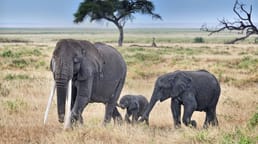

African elephants, the largest land mammals on Earth, knock down trees, pull up grass and plow trails through dense vegetation as they move across savanna and forest [2][5]. Those habits place them among the ecosystem engineers that ecologists classify as keystone species, organisms whose presence holds a habitat together [1][3]. The International Elephant Foundation states that without elephants, entire ecosystems in Africa and Asia would collapse [3]. Scientists have observed these landscape effects for decades, and more recently they have begun measuring how far the consequences reach for other species [5].
Ecologist Robert Paine coined the phrase keystone species in the 1960s, after an experiment on the rocky Pacific coastline of Washington state. Paine removed starfish that fed on mussels, and the mussel population swelled, crowded out other species and biodiversity dropped [1]. The label now covers predators, ecosystem engineers and mutualists, with the beaver as the standard engineer example [1]. Elephants fit the engineer category because they create, change and maintain habitats [5]. Keystone species is not a formal designation, so scientists still argue over which organisms deserve the title [1].
During drought, elephants sniff out water lying underground and use their tusks to dig down to it, opening watering holes that they then share [2]. Other animals drink from those holes too [2][3]. Footprints pressed into wet ground fill with water and become breeding pools for frogs and tadpoles [2][4]. Water scarcity makes each of those holes more valuable to the species living nearby [2].
Seeds travel through an elephant's gut and land in dung that fertilizes the soil around them [2]. African elephants disperse seeds from 335 plant species, and the dung supplies nutrients that help those seeds germinate and grow [2]. Because elephants cover long distances, they carry plants into new regions and create fresh habitat for animals there [2]. Their dung also serves as a microhabitat for beetles, centipedes, ants and other small creatures [4].
Trees take damage as elephants feed, and smaller animals move into the wreckage. Scientists compared similar areas where elephants were present and absent and found a greater diversity of small reptiles and amphibians where the elephants lived, possibly because broken branches and downed trees provide cover [5]. Elephants strip bark and splinter branches, which gives arboreal lizards sheltering spots [4]. Their grazing also holds back bush encroachment, which leaves more forage for other grazing animals [4].
Elephants push through thick undergrowth and leave trails that other species follow between patches of habitat [3][5]. Their movements open forest corridors and create natural firebreaks that protect the surrounding forest [4]. Conservation groups describe elephants as umbrella species as well, because the large areas they roam shelter many other species [4].
Between 1964 and 2016, African forest elephant populations fell by about 90 percent and savannah elephant populations by about 70 percent [4]. One estimate values the carbon a single African forest elephant captures over its lifetime at roughly US $1.75 million [4]. Habitat loss and conflict with people drive the decline, and conservation organizations argue that protecting elephant range protects the many species that share it [3][4].