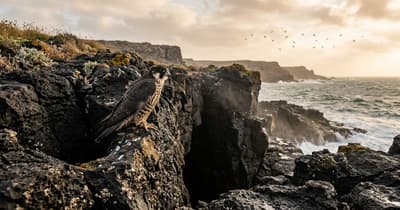
On Morocco's Mogador islands, a fisherman had apparently watched the falcons long enough to know their strangest trick. Small birds sometimes ended up wedged in rock holes, alive but unable to leave, while Eleonora's falcons nested above the Atlantic.[1]
Eleonora's falcons have been documented storing live prey in rock crevices after plucking flight feathers or trapping birds where they cannot move freely. Researchers interpreted it as a way to keep food fresh for later.
In 2015, Abdeljebbar Qninba and colleagues described the behavior from fieldwork in the archipelago off Essaouira. The birds they found looked different from ordinary leftovers. Some had their flight feathers removed. Others were pushed into narrow cavities where their wings and hanging legs had no room to work.[1]
Late in the breeding season, Eleonora's falcon meets a rush of exhausted travelers. Animal Diversity Web notes that the species breeds on Mediterranean islands and coasts, with young hatching around the migration period for many small Palearctic birds, then winters far away in Madagascar and nearby islands.[2]
A captured bird near a nest has a short useful life. Dead prey can dry out too quickly if the chicks do not eat it. The Mogador researchers suggested that keeping a bird alive for one or two days gave the falcons fresh food at the right moment, a grim little solution to a storage problem.[1]
BirdLife maps the species as a migrant with breeding areas around the Mediterranean and non-breeding range in the western Indian Ocean region.[3] The Moroccan cliffs sit along that seasonal logic: hungry chicks above, tired birds passing through, and volcanic rock full of ready made compartments.
The fisherman had been staying on the islands regularly for decades, according to the report. The researchers supplied names, dates, photographs, and a possible explanation. The old watcher on the islands supplied something humbler: the sense that this was a repeated habit in the rocks.[1]
A word like "imprison" can make the falcon sound almost human, as if it planned cruelty for its own sake. The cliff tells a colder story. A narrow fissure, a loosened set of feathers, and a nest full of mouths turn survival into a tiny piece of logistics.
The image at the end is hard to soften. Above the water, the adult bird rides the wind. Inside the rock, a small body stays fresh because it is still alive. The island has become a pantry, and the door is just a crack in stone.