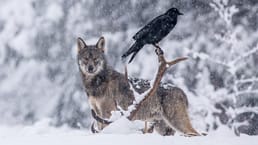
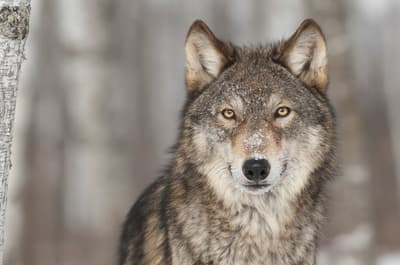
At Wild Spirit Wolf Sanctuary, the ravens do not behave like distant spectators. They land beside wolf enclosures, hop through winter snow, tease animals trying to enjoy a bone, and have even tried to make off with meat medication balls meant for the sanctuary’s rescues.[1]
Wolves and ravens have a documented mutual relationship: ravens follow wolves to carcasses and may guide them toward prey or dead animals, while wolves open food sources the birds could not easily access on their own.
Around a carcass, the old nickname “wolfbirds” begins to sound less like folklore and more like field notes. Ravens are scavengers with sharp eyes, loud calls, and the patience to shadow large predators. Wolves can bring down and open elk, deer, moose, and other large animals. Once the hide is torn and the meat exposed, ravens move in quickly, eating at the kill and sometimes caching food for later.[1][2]
Yellowstone wolf observers have reported ravens circling above injured, young, or sick animals, behavior that wolves may use as a cue during a hunt.[1] Ravens have also been seen calling excitedly when they find a carcass and leading wolves toward dead animals the birds cannot tear open by themselves.[1] The raven finds the locked pantry. The wolf brings the teeth.
The Bird That Waits For Teeth
A large carcass wrapped in hide is a physical problem for a bird. Intelligence helps ravens solve many things, but it does not give them wolf jaws. The birds can search from above, notice weakness, remember locations, and advertise food with calls and movement. Wolves can chase, kill, defend, and open a body that would otherwise remain sealed.[1][2]
On Isle Royale, the relationship has been studied through a different question: why do wolves often hunt in packs larger than a pair, when two wolves may be enough to kill large prey? Biologists John Vucetich and Rolf Peterson, who studied wolves and moose in the Lake Superior national park, found that resident wolves are almost always followed by ravens to a kill.[3]
At those kills, the usual crowd may include 5 to 20 ravens.[3] A raven can eat and cache about two pounds a day, and Vucetich estimated that if only two wolves were feeding on a moose kill, ravens could potentially take more than half of it.[3] In that light, a larger wolf pack may help keep dinner from disappearing one black beak at a time.
More Than Leftovers
The behavior does not stop at scavenging. Ravens are seen around wolves in sanctuaries, zoos, Yellowstone, and other wolf country.[1][3] Some accounts describe ravens approaching wolf packs even when no obvious meal is present, bobbing, tumbling, tugging at tails, and playing around wolf pups.[5] Younger wolves may tolerate or engage with the birds instead of simply driving them away.[5]
“Friend” is a cautious word in animal behavior, and the sources do not turn wolves and ravens into a fable. A raven at a kill is still a competitor with wings. A wolf is still a predator with teeth. Their association works because each animal brings a different skill to the same winter problem: finding meat, opening it, keeping it, and getting enough before someone else does.[1][2][3]
That is why the partnership can look playful one moment and ruthlessly practical the next. A raven circles over weak elk. A wolf looks up at the sound. Later, in the snow, the carcass is open, the pack is feeding, and black birds step close enough to steal while the meal is still warm.