
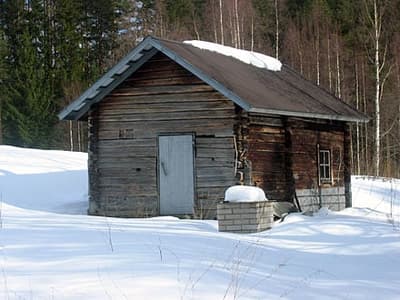
Finland has taken the sauna into apartment blocks, parliament buildings, corporate headquarters, churches abroad, and even 1,400 metres underground in a mine.[1] So perhaps the strangest part is not that Finns bring saunas everywhere. It is that they bring them to war.
That detail sounds like folklore the first time you hear it. An army in the field, and somewhere between mud, exhaustion, and artillery, someone is building a steam room. But in Finland, the sauna has never been a luxury add-on. It is not a reward after real life. It is part of real life. And that includes the hardest versions of real life.[1]
The sauna is so deeply embedded in Finnish culture that it functions less like a pastime than like an institution. In Finland, people do not merely like saunas. They inherit them, schedule around them, and treat them as one of the ordinary structures of existence, like the kitchen table or the front door. Those who have the opportunity usually take a sauna at least once a week, traditionally on Saturday.[1]
A Room That Follows the Nation
To understand why soldiers would build saunas in wartime, you have to understand what the sauna is in Finnish life. It is not just a hot room. It is a place for washing, sweating, recovering, and resetting. Historically, it was one of the cleanest spaces available, used not only for bathing but also for major life events. Over time, it became something even more durable: a ritual of physical and social equalization.[1]
That is why Finns kept building them wherever they went. On lakeshores. In city apartments. Inside office complexes. In the Parliament House. Abroad, too, wherever Finnish communities settled. The instinct is always the same. If Finns are going to be somewhere for any meaningful stretch of time, the sauna starts to feel less optional and more inevitable.[1]
War did not suspend that instinct. It revealed it.
The Wartime Sauna
During wartime, Finnish soldiers built and used saunas in the field.[1] On one level, this makes practical sense. A sauna offers warmth, washing, and relief in harsh conditions. It helps morale. It gives the body a chance to recover. But the persistence of the custom points to something larger than hygiene or comfort.
Even in war, the Finns carried with them a specific idea of what it meant to remain human. Not merely alive, not merely armed, but human. And the sauna was part of that package. In a society where the sauna was already woven into ordinary civilian life, leaving it behind entirely would have meant more than missing a habit. It would have meant severing a link to normality, continuity, and home.[1]
So they built them. Because of course they did.
Where Rank Stays Outside
And then there is the custom that makes the whole thing even more revealing. In the sauna, no titles or hierarchies are supposed to matter. The rule extends even to military saunas used by soldiers: rank stays outside.[1]
That is a remarkable social invention. Think about what it means. In almost every military setting, hierarchy is the air itself. It organizes speech, posture, obligation, authority. But in the sauna, Finnish custom suspends that order. Inside the steam, the officer and the private are not meant to perform their distance from one another. They are simply men, or simply people, sharing heat.
That does not mean the military stops being the military. Orders still exist. Structure still exists. War certainly still exists. But the sauna creates a temporary zone in which the body outranks the uniform. Everyone sweats. Everyone sits in the same heat. Everyone emerges red-skinned and human-sized.
It is hard to think of another national custom that so neatly expresses a culture’s values. Equality is not just preached here. It is architected. Bench, stove, steam, silence. That is the system.
The Logic of Finnish Equality
This is one reason the sauna matters so much in Finland. It is not only about heat or even cleansing. It encodes a worldview. The sauna is a place where boasting looks foolish, where titles become absurdly temporary, and where the body reminds everyone of its basic sameness. In ordinary life, that means business leaders and politicians are expected to follow the same etiquette as everyone else. In military life, it means even rank can be treated as something that does not belong in every room.[1]
That leveling effect is part of what gives the Finnish sauna its cultural force. Plenty of countries have bathing traditions. Fewer have one that doubles as a quiet social philosophy.
And that philosophy is not abstract. It lives in custom. Go into the sauna, and you leave certain things behind, status among them. You do not enter as a title. You enter as a person.
More Than a National Habit
It is tempting to translate all this into the language of wellness. Heat therapy. Relaxation. Recovery. But that framing is too thin for what the sauna means in Finland. The sauna is closer to a civic ritual, something between a household necessity, a cultural inheritance, and a code of conduct.[1]
That is why the wartime detail lands so powerfully. It reveals that the sauna is not just what Finns do when conditions are comfortable. It is what they preserve when conditions are not. When life shrinks to essentials, the things people keep tell you what they think a life is for. Finland kept the sauna.
And not as a private indulgence, either. As a shared room with rules. As a place where hierarchy softens. As a place where even soldiers are briefly returned to the same level bench.
That may be the most Finnish part of the whole story. Not simply that they built saunas in war, though they did. It is that once the sauna was built, the old etiquette still applied. No titles. No ranks. Just steam, heat, and the stubborn insistence that some spaces should remain human before they become anything else.[1]