When Genghis Khan gave instructions for his daughter Alaqai, the marriage sounded less like a family ceremony than a posting to a frontier command. In one account, he made clear that she was not being sent away simply to manage a household. She was being sent to rule.[2]
Genghis Khan’s “daughter diplomacy” used royal marriages to bind allied rulers to the Mongol family. His daughters married powerful leaders, their husbands were often drawn into Mongol campaigns, and the women could become rulers of strategically important territories themselves.
The instrument was old, but Genghis Khan gave it a harder edge. Royal daughters had long been married into neighboring courts to seal peace, exchange loyalty, or calm a border. Under the Mongols, those marriages became part of a wider system for securing allies, resources, and stability across an expanding empire.[1]
The wedding terms mattered. World History Edu describes Genghis Khan requiring some sons-in-law to make his daughters chief royal wives, and in some cases to divorce earlier wives.[1] That detail was political, not domestic. It put a Mongol woman at the highest rank inside another ruling house, above rivals who might otherwise dilute her influence.
After the marriage came the military obligation. Accounts of the policy say Genghis Khan often expected his sons-in-law to accompany him on campaigns.[1] A later summary puts the arrangement more bluntly: the husband went to war, while the daughter took over the work of rule at home.[2] If he died in combat, she was already in the palace, already tied to the local elite, and already recognized as the Khan’s daughter.
A Family Alliance Became A Border System
Along the Silk Road and other important routes, those marriages helped fasten distant powers to the Mongol center.[1] A daughter could hold together tribute, local loyalties, and a court that might otherwise drift away while Mongol armies rode somewhere else. The marriage bed and the military road were part of the same map.
That is why the daughters in these accounts are described as administrators, not ornaments. World History Edu notes that women who held power in this system were often educated to govern, because they might be responsible for territories while men were away at war.[1] The point was not simply to place a princess beside a ruler. It was to place a capable member of Genghis Khan’s own family inside a kingdom he needed to trust.
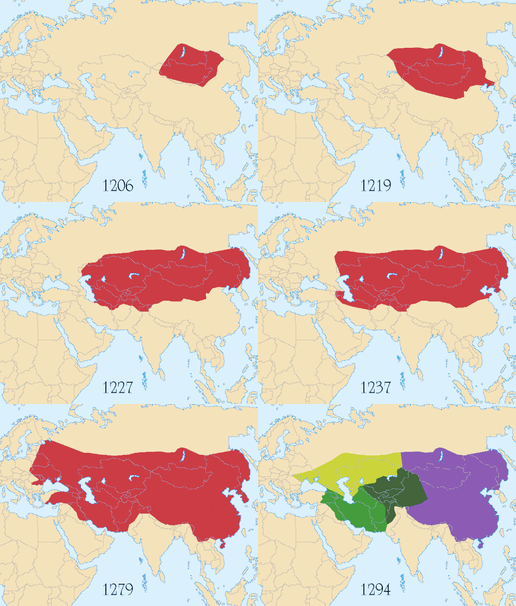
The broadest version of the story comes from the Rattibha summary, which says that by Genghis Khan’s death his daughters ruled across a vast arc “from the Yellow Sea to the Caspian.”[2] That line is a sweeping claim rather than a neat census of offices, but it captures the scale of the idea. Mongol power was not maintained only by cavalry charges. It also depended on marriages, widows, households, and women positioned where loyalty had to be watched closely.
The Arrangement Was Fragile
After Genghis Khan died, the same family politics that had made the system useful began to weaken it. The Rattibha account says his sons had inherited territories of their own, and one easy way to expand was to absorb lands held by their sisters.[2] As the daughters aged or died, male relatives took over their domains.[2]
The original claim is sometimes repeated in its sharpest form, that Genghis Khan married daughters to allied kings, sent the husbands to war, and left the women in control when those husbands died.[2] The more careful reading is slightly less tidy and more revealing. The policy did not need every son-in-law to die. It needed the daughters to be placed so high, and trained so well, that war made them the natural rulers left behind.
So the familiar picture of Genghis Khan needs one more object in the frame. Beside the horseman and the bow, there is a royal seal in a daughter’s hand, in a court far from Mongolia, while her husband rides with the army.