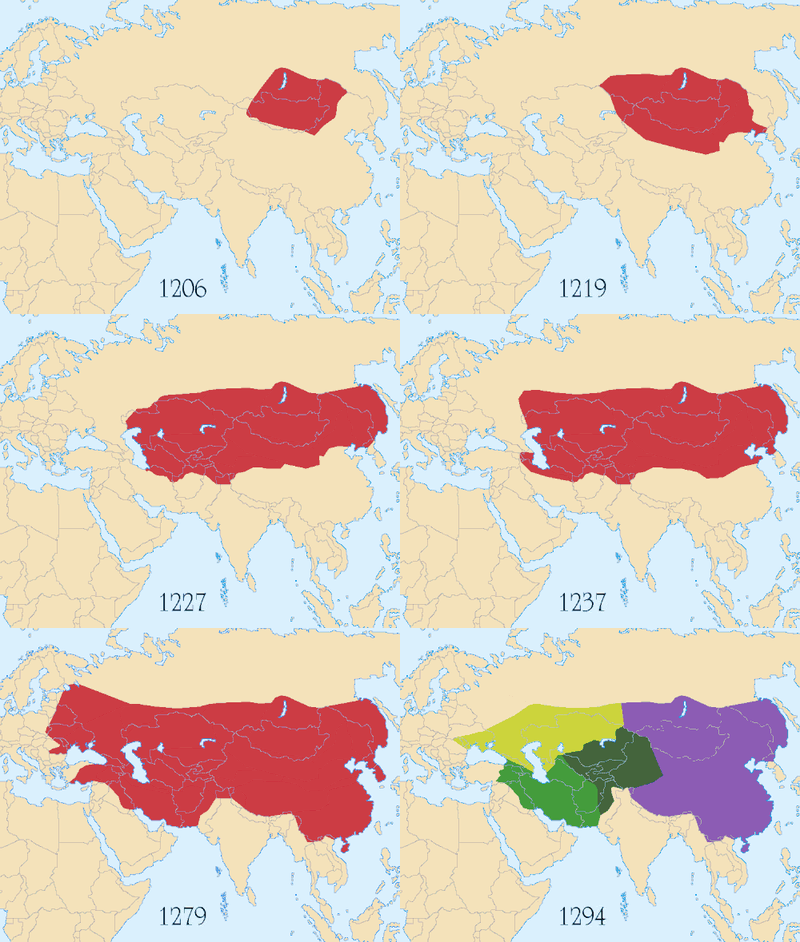
In 1219 the governor of Otrar executed a Mongol trade caravan and, by one account, smeared an ambassador's face with molten silver. Within two years the Khwarezmian Empire had ceased to exist [1]. Mongol armies destroyed cities that resisted and spared those that opened their gates, a graduated policy that let word travel ahead of the army and pushed many towns to surrender without a siege [1]. The campaigns killed an estimated forty million people, roughly a tenth of the world's population at the time [1].
At a kurultai in 1206, Temujin was proclaimed Chinggis Khan, or universal leader, before an assembly that The Secret History of the Mongols says drew nearly all of the million or so People of the Felt Walls [4]. He had been born around 1162 in northern Mongolia and spent two decades uniting rival tribes, partly by sharing spoils with his warriors instead of the aristocracy [2]. Once in power he issued the yassa, a body of rules governing relations between households, and later had it written down so the code and its records could be preserved [4].
The yassa made theft and robbery capital offenses and outlawed the enslavement of Mongols [4]. It banned adultery, the kidnapping of women, and the sale of women for marriage [4]. Hunting was forbidden during animals' mating seasons, and no household could kill more animals than it could use [4]. Summaries of his social policy list the same prohibitions on selling women, stealing property, and fighting [2][5][6].
Genghis Khan remained a Tengrist, yet the code he issued favored no religion and prohibited discrimination on religious grounds, which OpenStax calls perhaps the first law code to do so [3][4]. His administration exempted all religious leaders from taxation and public service [3]. Buddhist monks, Christian priests, Muslim imams, and Taoist masters paid nothing [1].
Kublai Khan invoked the exemption in a 1261 decree appointing the elder of the Shaolin Monastery, and his successors kept the same formula until the Yuan dynasty fell in 1368 [3]. The policy was not absolute. In 1264 Kublai levied commercial and land taxes on clergy who traded or farmed in China, and Jani Beg taxed the Orthodox Church in Russia in 1342 before restoring its exemption in 1347 [3]. Ögedei built houses of worship for Buddhists, Muslims, Christians, and Taoists in Karakorum [3].
The script Chinggis ordered became the first writing system created specifically for Mongolian, and alphabets derived from it are still used in Inner Mongolia [2]. His rule generally advocated literacy, religious freedom, and trade, though local customs that conflicted with Mongol practice were discarded [2][6]. Under Mongol rule Nestorian Christianity spread further into Asia, and trade routes linked Buddhist, Muslim, Christian, and Hindu populations [1].
Rashid al-Din records occasions when Genghis Khan forbade halal butchering, and Kublai revived the ban in 1280 along with a ban on circumcision before revoking it a decade later [3]. In 1221 in Afghanistan, Genghis dismissed the scholar Wahid-ud-Din after he criticized the scale of Mongol massacres [3]. Three of the four successor khanates eventually adopted Islam [3].