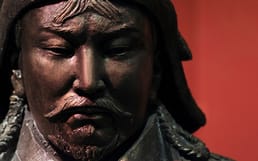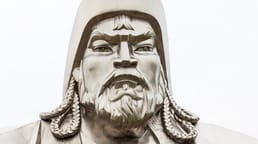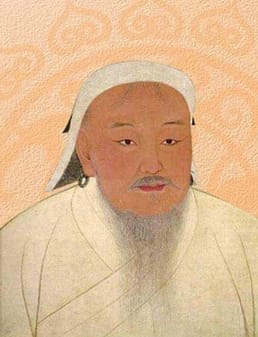
A grieving army carries a dead ruler home across Mongolia. In the story that keeps resurfacing online, anyone who sees the procession is killed. The mourners die, the killers die, and the last escort disappears with the only thing Genghis Khan seems to have wanted after death: an unmarked place where no one could find him.
The famous claim that around 2,000 people were killed to conceal Genghis Khan’s tomb is a legend, not a proven historical fact. His burial place remains undiscovered, but the mass-execution story does not appear in contemporary sources and is rated unproven by fact-checkers.
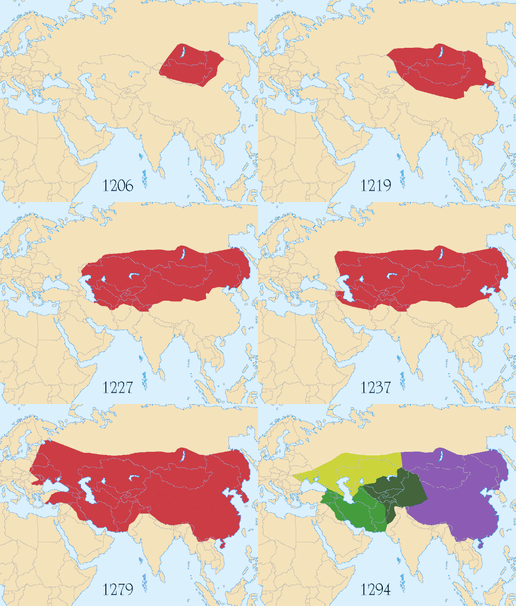
Genghis Khan died in August 1227, after ruling an empire that reached from the Pacific Ocean toward the Caspian Sea.[1] According to legend, he asked to be buried without markings or signs, and his body was returned to present-day Mongolia.[2] That part of the tradition matters because the most famous thing about his tomb is not what was put inside it. It is that no one has found the place.
The suspected region is near Burkhan Khaldun, a sacred mountain in the Khentii Mountains that was venerated by Genghis Khan and remains important in Mongol culture.[2] The Genghis Khan Mausoleum in modern Inner Mongolia is not the grave. It is a memorial site.[2] The actual burial place, if it survives, is still undiscovered.
The massacre story has a problem
The version that travels best is clean and horrifying. About 2,000 people attend the funeral. Soldiers kill them so they cannot reveal the route. Another group then kills those soldiers. In some tellings, the final escort kills itself. The secret is sealed one witness at a time.
Snopes examined that claim in 2024 and rated it “Unproven.”[3] The fact-check found no proof that more than 2,000 people were executed to hide Genghis Khan’s burial site.[3] The story seems to draw from Marco Polo’s account of Mongol imperial funeral customs, but the details do not match the viral claim.[3]
In The Travels of Marco Polo, Polo described a funeral convoy that killed people it met on the road, supposedly sending them to serve the dead ruler in the next world.[3] His numerical claim was not 2,000, but more than 20,000, and the ruler he named was Möngke Khan, Genghis Khan’s grandson and the fourth khan of the Mongol Empire.[3] Even that account has been questioned, and it does not establish that Genghis Khan’s own funeral ended in the layered execution story now repeated online.[3]
A grave made to vanish
The oldest Mongol source, The Secret History of the Mongols, gives the year of Genghis Khan’s death but says nothing about his burial.[2] Marco Polo later wrote that even by the late 13th century, the Mongols did not know the tomb’s location.[2] Whether that was ignorance, silence, or something told to outsiders cannot be proven from the surviving material.
Other legends filled the gap. One says a river was diverted over the grave.[2] Another, reported by the BBC, says soldiers rode 1,000 horses over the burial site to destroy every trace.[1] The details change, but the shape of the story stays the same: the grave was not meant to become a destination.
Modern searches have not broken that silence. Expeditions have worked through historical texts, crossed the landscape, and even used satellite imagery, including National Geographic’s Valley of the Khans Project.[1] The BBC notes that much of the pressure to locate the tomb has come from outside Mongolia, while many Mongolians prefer that it remain undisturbed.[1]
That reluctance is sometimes described as superstition. In the BBC’s reporting, a Mongolian translator named Uelun gave a plainer reason: respect.[1] Genghis Khan did not want to be found.[1]
So the funeral massacre belongs to legend rather than established history. The missing tomb is real enough. The secrecy is old enough. But the neat chain of 2,000 mourners, murdered soldiers, and doomed escorts has no solid contemporary footing. What remains is not a proven bloodbath, but an absence: somewhere near a sacred mountain, a grave with no marker telling anyone where to stop.