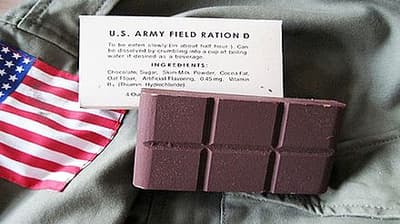
In April 1937, an Army quartermaster officer named Paul Logan met with Hershey Chocolate Corporation president William Murrie and chief chemist Sam Hinkle at the company's offices in Hershey, Pennsylvania. Logan represented the office of the Army Quartermaster General, a branch established on 16 June 1775 and responsible for subsistence, among other supply functions [4]. The meeting began the first experimental production of a chocolate ration bar for the United States Army [2][6].
Logan set four conditions for the bar: it had to weigh four ounces, carry a high food energy value, withstand high temperatures, and taste, in his phrasing, a little better than a boiled potato [2][6]. The last requirement was deliberate, since a bar that tasted good would be eaten before an emergency arrived [6]. Milton Hershey, who founded the company in 1894 as a subsidiary of his Lancaster Caramel Company, was told about the visit and instructed Murrie and Hinkle to begin work immediately [1][3][6].
After three days of experiments with blending and processing, Hinkle settled on a mixture of chocolate liquor, sugar, skim milk powder, cocoa butter, oat flour, and vanillin, with sugar reduced and chocolate liquor increased to make the bar less appealing than ordinary chocolate [6]. Thiamine hydrochloride went in as a source of vitamin B1 to prevent beriberi, a disease troops were likely to meet in the tropics [2][6]. The result was a heavy paste that would not flow at any temperature, so standard chocolate machinery could not handle it [6].
In June 1937, Hershey took on an order for 90,000 bars, and production ran three weeks because each four-ounce portion had to be weighed, kneaded, and pressed into a mould by hand [6]. The finished bar was a hard block of dark brown chocolate that crumbled with effort and held its shape up to 120 °F (49 °C) [2][5]. Each bar carried about 600 calories, and three bars made a daily ration of roughly 1,800 calories [2][6].
Field tests sent the bars to the Philippines, Hawaii, Panama, the Texas border, and Army posts and depots across the United States [6]. Some of them reached Admiral Richard E. Byrd's Antarctic expedition [2][6]. The tests were judged satisfactory and Field Ration D was approved for wartime use, with small contracts placed at irregular intervals between 1937 and 1941 [6].
After the attack on Pearl Harbor on 7 December 1941, the Quartermaster Corps required protection against poison gas, and that protection went into the packaging rather than the chocolate [6]. Each bar was sealed in a heavy cellophane bag, placed in a cardboard carton with glued ends, and the carton was dipped in a wax mixture [6]. Twelve bars went into a coated carton and twelve cartons into a wooden crate, 144 bars in all [2].
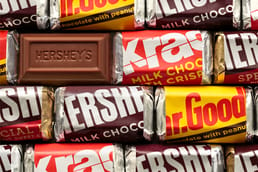
The Hershey Company produced the majority of chocolate issued to US military personnel, and it made more than one kind [2]. K rations issued in temperate climates sometimes carried a bar of Hershey's commercial sweet chocolate, molded thick and rectangular rather than flat, while tropical regions received the Tropical Bar formula [2]. Emergency ration bars never drew enthusiastic reviews from troops, even after attempts to improve the flavor [2].
Milton Hershey died on 13 October 1945 [3]. The company he left behind, headquartered in Hershey, Pennsylvania, sells chocolate in 60 countries [1]. Its wartime work on a special non-melting bar for troops serving overseas remains part of the company's history [3].