Imagine a time before recorded history. Thirty thousand years ago, the world was a vastly different place—a landscape of wandering mammoth herds and ice-choked tundras. Deep beneath the Siberian permafrost, tucked away in a frozen tomb of ancient ice, something was waiting. It wasn't a fossil, and it wasn't a relic. It was a biological time capsule, perfectly preserved and, most importantly, perfectly intact.
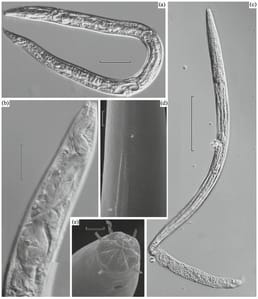
In 2014, when researchers extracted an ice core from the Siberian permafrost, they weren't just looking for climate data; they were looking into the past. What they found instead was a waking nightmare from the Pleistocene: Pithovirus sibericum, a "giant virus" that had been dormant for thirty millennia, just waiting for the right conditions to breathe again.
The Monster in the Microscopic World
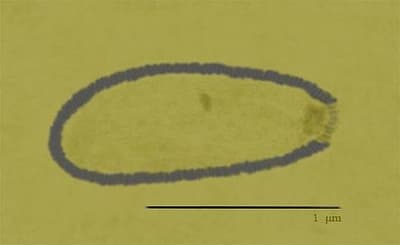
For most of biological history, viruses have been viewed as tiny, almost ethereal entities—invisible specks that slip through the cracks of cellular defenses. But Pithovirus defies the very definition of what a virus "should" be. Named after the pithoi—the massive, heavy storage jars used in ancient Greece—this virus is anything but subtle[1].
Measuring approximately 1.5 micrometers in length and 0.5 micrometers in diameter, Pithovirus sibericum is a behemoth by viral standards[1]. It is a member of the nucleocytoplasmic large DNA viruses (NCLDV) clade, a group of viruses possessing complex genomes and structures that blur the line between "virus" and "living organism." In fact, it is roughly 50% larger than many of its relatives, making it one of the most massive viruses ever documented[1].
But size isn't its only startling feature. Its structure is distinct, characterized by a unique, ovoid shape that allows it to house a massive double-stranded DNA genome—a biological blueprint that had remained unread for thirty thousand years.
The Resurrection
The most unsettling aspect of the 2014 discovery wasn't the virus's size or its ancient origins—it was its vitality. When scientists brought the specimen out of the frozen dark and into a controlled environment, the Pithovirus didn't behave like a dead piece of organic matter. It behaved like a predator.
As soon as the virus was introduced to its host—the amoeba—it began to function. It didn't just infect the cells; it systematically dismantled them. The virus was fully infectious, proving that the extreme cold of the Siberian permafrost hadn't just preserved its shape; it had preserved its ability to replicate. The 30,000-year-old biological machine simply waited for the thaw, and when it arrived, it went straight back to work[1].
The Permafrost Problem
The discovery of Pithovirus sibericum has sent a ripple of unease through the scientific community. It serves as a "proof of concept" for a terrifying possibility: the permafrost is not just a graveyard; it is a library of ancient pathogens.
As the Arctic warms at an unprecedented rate, the very ice that has acted as a planetary stabilizer is beginning to fail. We are seeing more frequent melting and more aggressive drilling for resources in these northern latitudes. Every time a layer of permafrost thaws, or a drill bit pierces an ancient ice sheet, we are essentially opening a door to a room we haven't entered in tens of thousands of years.
While Pithovirus specifically targets amoebas, the precedent it sets is chilling. It proves that viruses can remain viable across geological timescales. The question is no longer if ancient pathogens can be unearthed, but which ones will emerge, and whether our modern immune systems, evolved for the pathogens of today, will even recognize the enemies of thirty thousand years ago.