
Alexandria became the Ptolemaic capital after Alexander the Great's general Ptolemy I Soter founded the kingdom in 305 BC, and Ptolemy I commanded construction of the Library of Alexandria and the Lighthouse [1][8]. Demetrius of Phalerum, an exiled Athenian statesman, may have proposed the library to Ptolemy I, though the library itself was probably not built until the reign of Ptolemy II [3][6]. The library formed part of the Mouseion, a research institution dedicated to the Muses [3][5].
Ptolemy II Philadelphus ruled from 284 to 246 BC and promoted the Museum and Library [4]. The Mouseion probably took shape under him, and its scholars and staff were salaried by the state and paid no taxes [5]. According to Strabo, they also received free room and board and servants, and the Mouseion included a roofed walkway, a columned hall, and a large dining hall in the Brucheion palace complex [5].
The Ptolemies funded an aggressive acquisition policy, and agents bought texts across the Mediterranean [3][9]. Accounts also say ships arriving in Alexandria were searched for books, which were copied and the originals retained [9][10]. The practice produced the term ship libraries for confiscated collections housed in the Great Library [10].
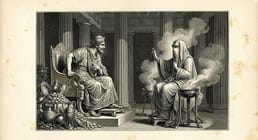
Ptolemy III Euergetes, who ruled from 246 to 222 BC, sent a letter to all the world's sovereigns asking to borrow their books [2][10]. When Athens lent him the texts of Euripides, Aeschylus, and Sophocles, he had them copied, returned the copies, and kept the originals, forfeiting the collateral [10]. During his reign a daughter library was established in the Serapeum [3].
Callimachus compiled the Pinakes, a catalog in 120 volumes, around 245 BC [7]. It divided works into six genres of poetry and five sections of prose and alphabetized each category by author [7]. The library stored scrolls in bins grouped by subject, with labels and entries giving title, author, biography, first line, summary, and doubts about authenticity [7]. Estimates of total scrolls range from 40,000 to 700,000 [3].
Zenodotus of Ephesus worked toward standardizing Homer, and Apollonius of Rhodes composed the Argonautica [3]. Apollonius later headed the Library and tutored Ptolemy III [2]. Eratosthenes calculated Earth's circumference within a few hundred kilometers; Hero documented a steam engine; Aristophanes of Byzantium invented Greek diacritics; Aristarchus produced definitive Homeric texts [3].
In 145 BC, Ptolemy VIII Physcon purged intellectuals from Alexandria [3][5]. Aristarchus of Samothrace resigned as head librarian and exiled himself to Cyprus; Dionysius Thrax and Apollodorus of Athens fled [3]. Julius Caesar burned part of the collection in 48 BC, though the extent is unclear [3]. Strabo visited the Mouseion around 20 BC, and membership appears to have ceased by the 260s AD [3]. The Serapeum was demolished in 391 AD [3]. Modern accounts stress gradual decline rather than a single destruction [11].