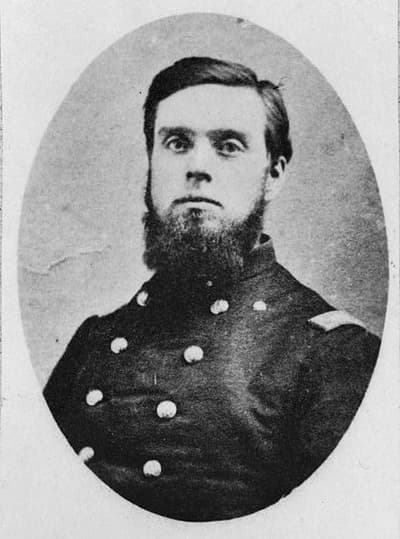
Colonel John T. Wilder commanded the Union mounted infantry brigade known as the Lightning Brigade during the American Civil War, which began on April 12, 1861, when Confederate forces bombarded Fort Sumter [1]. Wilder was born on January 31, 1830, and died on October 20, 1917. His brigade became known for mobility and firepower in the western theater, where Union forces made permanent gains in 1861 and 1862 [1].
Before the Civil War, Wilder worked as an engineer and operated two blast furnaces in the South. When the war began, the Union Army expanded through volunteer regiments, and Union brigade-level officers could receive commissions in the U.S. Volunteers rather than the regular army [2]. Most Civil War generals held volunteer or brevet rank, and regular rank was considered superior [2]. Wilder's command fit that volunteer structure, and his prewar industrial experience gave him a practical interest in new equipment.
In 1863 Wilder moved to equip the brigade with Spencer repeating rifles. The Ordnance Department had not issued repeating rifles to the brigade, so Wilder arranged a purchase. The soldiers agreed to pay for the rifles from future pay, and Wilder guaranteed the transaction. The Union's Northeast and Midwest produced large quantities of munitions and supplies, and mass-produced weapons were widely used in the war [1][3]. The Spencer rifles reached the Lightning Brigade before the Ordnance Department supplied them.
On June 24, 1863, Wilder's brigade led the Union advance in the Tullahoma Campaign in central Tennessee. The brigade seized Hoover's Gap, a key mountain pass, and held it against Confederate counterattacks. Victory at the gap was attributed largely to Wilder's persistence in procuring the new rifles. The action came during a war in which railroads, the telegraph, steamships, ironclad warships, and mass-produced weapons were widely used [1].
At Hoover's Gap, the brigade's Spencer rifles delivered a volume of fire that Confederate defenders did not expect. The repeating rifles allowed mounted infantry to disorient the enemy and to hold the pass until support arrived. Union industrial capacity in the loyal states provided the munitions and supplies that made such firepower possible [3]. The brigade fought on foot after riding to the position, which combined mobility with the new rifles' rate of fire.
Wilder's brigade was mounted infantry, not cavalry; the men rode to the fight and then fought on foot. That tactical combination mattered at Hoover's Gap, where speed of movement and sustained fire both shaped the engagement. The Union's loyal states north of the Mason-Dixon line supplied most of the army's soldiers, food, horses, financial support, and training camps [3]. Wilder's command drew on that broader Union mobilization while adding a weapon the Ordnance Department had not yet supplied.
Wilder lived until October 20, 1917, long enough to see the Civil War become one of the most extensively studied episodes in American history [1]. The Lightning Brigade's action at Hoover's Gap remained tied to the Spencer rifle and to Wilder's decision to secure the weapons before the government supplied them. His prewar work as an engineer and furnace operator stood apart from his wartime role, but both careers reflected the industrial turn that shaped the Union war effort [1][3].