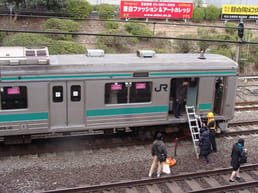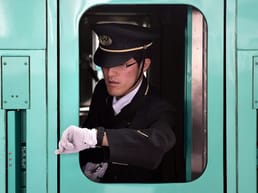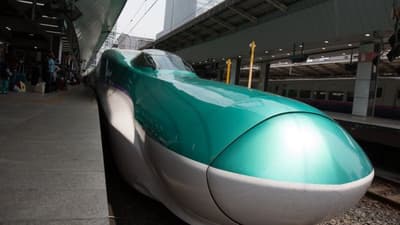
The Tōkaidō Shinkansen opened on 1 October 1964, when Hikari 1 left Tokyo for Osaka and Hikari 2 ran the other way [4]. Work had started on 20 April 1959, and the opening was timed to the Tokyo Olympics [2][4]. In 2017 a Japanese railway company apologised for dispatching a train 20 seconds early and described the lost seconds as severe inconvenience [1].
Japan's high-speed trains arrive at their final stop an average of 54 seconds behind schedule, a figure that includes delays from natural disasters and other causes outside the operator's control [1]. On the Tōkaidō Shinkansen, an average of 378 trains ran each day in fiscal 2019 with an average delay of 12 seconds [4]. The 54-second figure covers final-stop arrivals across the high-speed network; the 12-second figure records delay on one line [1][4].
A train running five minutes or more behind schedule earns its passengers a certificate [1]. They can show it to an employer or a teacher as an excuse for being late [1]. The practice turns a delay into a document a commuter can hand over.
Switzerland's railway reports that 89.7% of its trains were on time between January and October, while 88.3% of British services met that description over 12 months [1]. The two countries measure differently. The Swiss count a train as late once it arrives more than three minutes after the advertised time; in Great Britain a train can be five minutes late and still count as on time [1].
Shinkansen routes now cover 2,951.3 km at maximum speeds of 260 to 320 km/h, the fastest on a 387.5 km section of the Tōhoku Shinkansen [2]. The network recorded 385.9 million passenger journeys in 2024 [2]. The original Tōkaidō route runs 552.6 km and links Tokyo, Yokohama, Nagoya and Osaka, the four largest cities in the country; it carried 161 million passengers in fiscal 2023 and more than 6.5 billion since opening [2].
Up to 16 trains an hour run in each direction on the Tōkaidō Shinkansen at peak periods, using 16-car sets with 1,323 seats and a minimum scheduled headway of three minutes [2]. JR Central has operated the line since 1987, when it passed from Japanese National Railways, and runs three service types: Nozomi, Hikari and Kodama, with up to 17 trains an hour [4]. In 2000 the line was named a Historic Mechanical Engineering Landmark and an IEEE Milestone [4].
Japan is prone to frequent earthquakes, has soft ground and mountainous terrain, includes regions with heavy snowfall and faces space constraints in its cities [2]. Shinkansen lines have narrower spacing between opposing tracks, smaller minimum curve radii and smaller tunnel cross sections than high-speed railways elsewhere [2]. The long noses on newer trainsets reduce the compression-wave boom produced when a train enters a small tunnel, keeping noise inside regulation [2].
More than 100 companies provide rail services in Japan, among them six Japan Railways Group companies that were state owned until 1987 and 16 major private operators [3]. About 30,625 km of track crisscrosses the country, and the railways carried 9.147 billion passengers in 2013-14 [3]. Japan has 46 of the world's 50 busiest stations [3]. Away from the high-speed lines, conventional trains mostly run below 130 km/h [3].