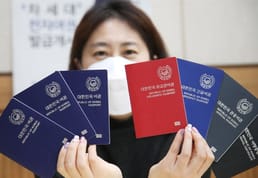
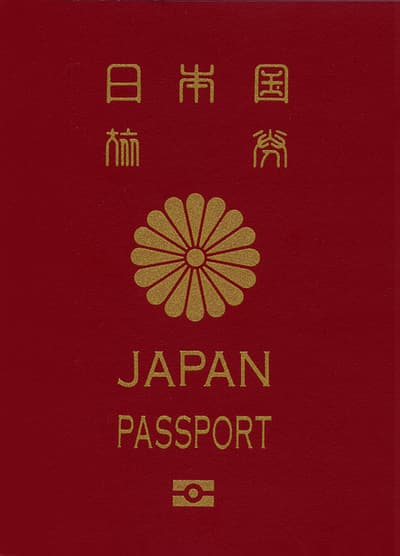
Japan has issued biometric passports to all applicants since 20 March 2006 [3]. Each booklet carries a contactless chip holding a digitised photograph and a digital signature, built to the International Civil Aviation Organization's Doc 9303 standard [2]. More than 150 jurisdictions issue such passports as of July 2024 [7]. Ten-year ordinary passports have crimson covers; five-year passports, the only kind issued to citizens under 17, are dark blue [3]. The chrysanthemum crest sits at the centre of the front cover, with the characters for Nipponkoku Ryoken above it and JAPAN PASSPORT below [3].
The earliest Japanese travel document on record went to Namigoro Sumidagawa, an acrobat and magician who received a stamped letter of request on 17 October 1866 so he could perform at the 1867 Exposition Universelle in Paris [3]. The word for passport entered the Japanese language in 1878, the first regulations governing passports followed in 1900, the modern booklet form appeared in 1926, and machine-readable passports arrived in 1992 [3].
The 2026 Henley Passport Index puts Singapore first, with access to 192 of 227 destinations, and places Japan, South Korea and the United Arab Emirates joint second [1][5]. Country-level summaries for the same year credit Japan with 187 destinations and South Korea with 187, both ranked second [4][6].
Japan held first place from 2018 to 2022, fell to second in 2023 and 2024, and stood second in April 2025 with 190 destinations [3][4]. Henley updates the ranking quarterly, so scores shift as visa policies change [1].
Christian Kalin created the ranking in 2005 as the Henley & Partners Visa Restrictions Index and renamed it the Henley Passport Index in January 2018 [1]. Each of 199 passports is checked against 227 destinations in the IATA Timatic database, for an adult travelling alone on an ordinary passport for tourism or business [1]. Visa-free entry, visas on arrival and automatically approved electronic travel authorities score one; e-visas that need government approval score zero [1].
The Global Passport Index, published by Global Citizen Solutions, places Japan 21st with visa-free access to 110 countries [8]. Visafreecountries.com counts 139 visa-free destinations, 61 e-visas and 14 visas on arrival, ranking Japan 21st among 193 passports [9]. The Henley figure counts visa on arrival and electronic travel authorisation alongside visa-free entry, which accounts for part of the gap between the three counts [1].
The Ministry of Foreign Affairs issues five categories of passport: ordinary, official for National Diet members and public servants, diplomatic for the Imperial Family and diplomats, emergency, and a single-use Travel Document for Return to Japan [3]. The Emperor and Empress hold no passports, under conventions covering heads of state [3]. Each passport carries a request from the Minister for Foreign Affairs asking authorities abroad to let the bearer pass without obstruction and to give protection if needed [3].
Visa-free entry does not remove every condition at the border. Angola, Benin, Ghana, Cote d'Ivoire and a dozen other African countries require incoming travellers to show a yellow fever vaccination certificate, and French Guiana does the same [4]. Many destinations, including India, Indonesia, Kenya and Saudi Arabia, require a passport valid for at least six months on arrival [4]. APEC Business Travel Card holders travelling on business skip visa applications in member economies, though Canada and the United States do not treat the card as a visa [4].
Sources
- Wikipedia: Henley Passport Index
- Wikipedia: Biometric passport
- Wikipedia: Japanese passport
- Wikipedia: Visa requirements for Japanese citizens
- Wikipedia: Visa requirements for Singapore citizens
- Wikipedia: Visa requirements for South Korean citizens
- Wikipedia: Passport
- globalcitizensolutions.com
- visafreecountries.com