In 1926, American boys were told to act as ticket agents. Girls were asked to dress the passengers. Each doll needed a railroad and steamer ticket, priced at ninety-nine cents, and a passport that cost one cent before she could leave for Japan.[1]
In 1927, American children sent thousands of "blue-eyed dolls" to Japan as small ambassadors, complete with tickets, passports, farewell parties, and letters. Japan answered with 58 large friendship dolls that toured American cities and settled in museums and libraries.
Sidney Gulick had lived in Japan for two decades before he asked American children to try a softer kind of diplomacy. By the mid-1920s, anti-Japanese feeling in the United States had hardened into law, including the Immigration Act of 1924, which ended Japanese immigration to the country.[2] Gulick helped form the Committee on World Friendship Among Children, a name that sounds sweet until the paperwork starts appearing.
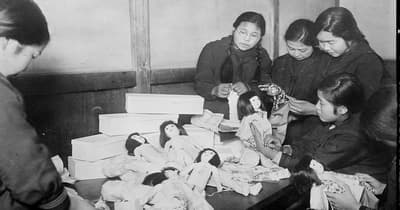
At schools and churches, the assignment became practical: name the doll, clothe her, exhibit her, give her a farewell party, and send her away with documents. The committee's 1929 account explained that a passport was a letter of introduction assuring Japan that the traveler was a well-behaved citizen of the United States.[1]
By the final count, 12,739 dolls had been sent through Japan's Department of Education, with more forwarded privately.[1] They arrived in time for Hinamatsuri, the Doll Festival, and were distributed to schools. The make-believe travel ritual did real work. A child did not have to understand exclusion law to understand a guest.
In November 1927, Japan answered with 58 large Ichimatsu dolls for the United States. Each stood about thirty to thirty-two inches tall, with gofun faces, human hair, glass eyes, silk clothing, and accessories that could include lacquered furniture, tea sets, folding screens, parasols, and wooden geta.[2][3] One went to each of the 48 states. Others represented major cities, the imperial household, and Japanese territories.[3]
Miss Miyazaki eventually belonged to Minnesota, and Miss Hamako Yokohama spent years in Colorado's library and museum world.[2][3] Their names carried places into rooms where most children would never see Yokohama or Miyazaki. Later scholarship has complicated the exchange, noting that American goodwill often pictured Japan through the safe, charming figure of a kimono-clad little girl.[4] Even a friendly gift can carry a small, stubborn misunderstanding.
On a classroom desk, the passport made the gesture harder to dismiss as mere sweetness. The project took a diplomatic wound and made it small enough for children to handle. A national law had said some people could not cross. Children answered by sending a doll with a ticket, a paper identity, and instructions to be received kindly in someone else's country.
Before the ship sailed, a doll waited in a box with papers everyone knew were pretend. Then the box moved anyway, toward the sea.
Sources: