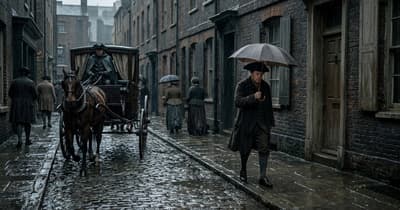
Jonas Hanway chose a strange way to be annoying. In the early 1750s, after returning from France, he walked through rainy London with an umbrella over his head. People did not quietly admire the practicality. Atlas Obscura describes bystanders hooting, jeering, and staring at him as if he had dragged a foreign joke into the street.[1]
Jonas Hanway is often remembered as the first male Londoner to carry an umbrella in public. The object that later became ordinary rain gear first looked, to many Londoners, like a French, feminine, and faintly ridiculous refusal to get wet.
Notes and Queries later put the comedy in one sharp line: Hanway lived long enough to triumph over the hackney coachmen who tried to hoot and hustle him down.[2] Their irritation was practical as well as theatrical. A pedestrian who could keep himself dry was one fewer wet customer climbing into a carriage.
In London streets already crowded with rain, mud, horses, and hired coaches, the umbrella carried a second weather system around it. Women had used umbrellas earlier, and French fashion had helped make the device familiar across the Channel. For English men who cared about respectability, the problem was what the object seemed to say before it kept off a single drop.
Westminster Abbey's short memorial biography gives Hanway a busier life than the umbrella anecdote suggests. He was a merchant, writer, philanthropist, founder of the Marine Society, and advocate for poor children and chimney sweeps.[3] He wrote on trade, charity, prisons, tea, and public morals. The man under the umbrella had a long habit of asking whether ordinary customs deserved obedience.
On a wet pavement, that habit needed no pamphlet. Each walk staged the argument in miniature: one man staying dry while strangers treated discomfort as a badge of character. The jeers did not prove the device was useless. They proved the device had arrived before the manners needed to absorb it.
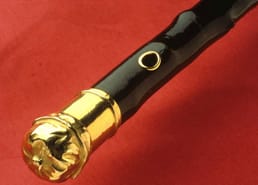
Decades later, a wet pedestrian could open an umbrella without turning the street into a little theater. The same curved handle that once invited laughter became the sensible thing to grab before leaving home. The stubborn part was never the rain. It was the crowd deciding when a useful object had stopped looking ridiculous.
Hanway died in 1786, with a memorial in Westminster Abbey and a reputation that wandered far beyond rain gear.[3] Still, the image that lasts is smaller than a monument: a man crossing a wet London street beneath black fabric, coach wheels nearby, laughter in the air, holding on to the future by a curved handle.