
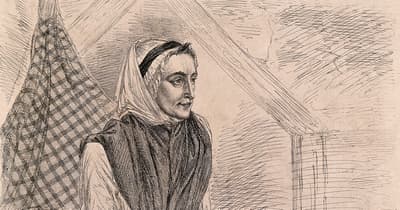
When Ann Moore learned that investigators wanted to put her bed on a weighing machine, she objected for a reason they recorded carefully. Losing weight would make it look as though she was wasting away without food; gaining it would suggest she had managed to eat behind their backs. Either result, she argued, could be used against her after years of claiming she could live without food.[3]
By 1813, visitors had been coming to see Moore in Tutbury, Staffordshire, for years. She had begun making her claim in 1807, and an earlier investigation had given them something reassuring to point to. In September 1808, she underwent a sixteen-day watch at a local grocer's house, with water permitted during the first three days. The watch ended without exposing her, and people continued to visit and leave gifts.[1]
Among the visitors in 1812 was Alexander Henderson, who stopped with two companions during a journey to the Lakes. Whenever they raised doubts with people nearby, supporters referred them to the watch. Henderson came away with observations he found harder to reconcile with Moore's story: she looked thin but reasonably healthy, her mouth contained saliva, and a mirror held before her face clouded with moisture. There was also a smell of urine around the bed, he reported, although she said she no longer passed any. His published objections appeared in 1813, when a new committee was preparing a much closer watch.[2][3]
For this attempt, the committee planned four weeks of observation and restricted who could get near her. Its report describes a search of her upstairs room, the removal of unnecessary furniture and a new bed filled with chaff in front of witnesses. A porter guarded the entrance downstairs, and a rope across the room kept others away from the bed. Moore eventually withdrew her objection to weighing. The watch began on April 21; when the machine arrived on April 26, her bedstead was placed on it, with the readings covering Moore, bed and bedding together.[3]
As the days passed, Moore became feverish and increasingly weak, asking for a wet handkerchief to moisten her mouth. At first the watchers wrung it almost dry, but a surgeon who feared for her life eventually let her use a wetter one. The observers still disagreed about whether she was swallowing liquid, and some attributed her illness to a cold. By April 30, doctors were warning that she might soon die. Moore asked them to stop, and the committee ended the watch.[3]
Even after it ended, she insisted she had deceived nobody. Investigators searching further found concealed linen and discovered that she had substituted a clean garment for one they wanted to examine. On May 4, she put her mark to a confession admitting she had occasionally taken sustenance during the previous six years. The committee ordered it printed for handbills and newspapers.[3]
During the inquiry, her daughter described what happened after the family finished its tea. She left the teapot on a shelf within her mother's reach, sometimes adding milk and sugar. Although she said she had rarely seen her mother drink, she believed Moore helped herself in her absence.[3]
Sources
- Tom Ruffles, The Skeptic: Ann Moore, The Fasting Woman of Tutbury (originally 1992)
- Alexander Henderson, An Examination of the Imposture of Ann Moore (1813)
- Legh Richmond, A Statement of Facts Relative to the Supposed Abstinence of Ann Moore (1813)
Hero image: Ann Moore, etching by James Ward. Wellcome Collection, via Wikimedia Commons, CC BY 4.0. Cropped from the original print.