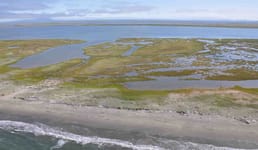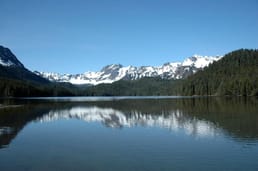
On the shore of Issyk-Kul, a person can stand on sand, look across clear water, and see snowy mountains crowding the horizon. The scene has the props of a seaside holiday, with beaches, kayaking, swimming, and sunsets over a broad blue surface, but the country around it has no coastline at all.[1][2]
Kyrgyzstan is the country farthest from any ocean, with its nearest coastline about 1,620 miles away on the Indian Ocean. The surprise is that this deeply landlocked Central Asian nation is also known for mountain lakes, high valleys, and beachlike shores.
Kyrgyzstan’s border tells the basic story. The country sits in eastern Central Asia, with Kazakhstan to the north, China to the east and southeast, Tajikistan to the south, and Uzbekistan to the west.[4] Its coastline is listed as 0 kilometers, and among landlocked countries it is identified as the farthest from any ocean.[3][4]
The distance usually attached to the claim is 1,620 miles, measured to the nearest coastline on the Indian Ocean.[1][2] That does not make Kyrgyzstan the largest landlocked country, since Kazakhstan holds that distinction. It is also not one of the two doubly landlocked countries, Liechtenstein and Uzbekistan, which are surrounded only by other landlocked countries.[3] Kyrgyzstan’s distinction is narrower and stranger: as a national territory, it sits farther from the sea than any other country.
A Landlocked Country Full of Water
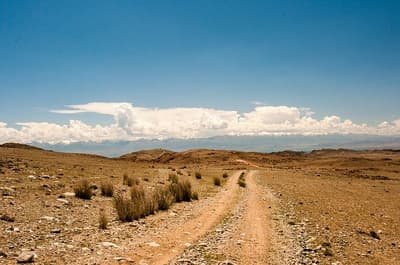
Mountains make the usual mental picture of “landlocked” fall apart. Kyrgyzstan’s terrain is dominated by the Tian Shan and Pamir mountain systems, which together occupy about 65 percent of the country.[4] A travel account describes the impression even more strongly, saying mountains cover four-fifths of its land.[1]
The elevations are severe enough to make the country feel built upward. Kyrgyzstan’s average elevation is about 2,750 meters, or 9,020 feet, and Jengish Chokusu rises to 7,439 meters, or 24,406 feet.[4] Across a territory that stretches roughly 900 kilometers east to west and 410 kilometers north to south, those heights produce ridges, valleys, rivers, and high basins instead of a flat interior.[4]
Then the lakes complicate the joke. Song-Kul is a remote alpine lake near the center of the country, known for its quiet setting and difficult approach.[1][2] Issyk-Kul is easier to reach and far larger, described as the world’s second-largest alpine lake.[1][2] It has clear water and sandy stretches, and despite the snow-capped peaks around it, the lake does not freeze because of its salt levels.[2]
The technical footnote is that Kyrgyzstan does not contain the single point on Earth farthest from any coastline. That spot, often called a point of inaccessibility, lies in the Dzungarian Basin of northwestern China, near the region where China, Mongolia, Kazakhstan, and Russia come close together.[1][2] Kyrgyzstan wins the country category. The Dzungarian Basin wins the pinpoint category.
Even Kyrgyzstan’s tourism ambitions gather beside inland water. One reported plan, Asman, is a proposed city on Lake Issyk-Kul, described as a green and sustainable development shaped like a komuz, a traditional Kyrgyz instrument.[5] For a country 1,620 miles from the nearest ocean, the imagined future still begins on a shore, with a lake in front and mountains behind it.
Sources
- Central Asia Rally, “Kyrgyzstan: The Furthest Country From Any Ocean”
- Daily Express, “The country you may have never heard of that's the furthest from any ocean”
- Wikipedia, “Landlocked country”
- Wikipedia, “Geography of Kyrgyzstan”
- Daily Express, “The tiny country that's further away from the sea than any other”