Imagine a merchant sailor in the early 19th century. Midnight. The Atlantic is churning, and a suffocating fog has swallowed the horizon. You scan the darkness, praying for a sign of land, when a light suddenly appears. It is steady. It is bright. But as you watch, a cold realization sets in: Is that a lighthouse, or a ship on the horizon? Is it a coastal village, or a star caught in the mist?
In the era before GPS, a light that didn't "speak" was a light that couldn't be trusted. To a navigator, a steady light was an ambiguity—and in a storm, ambiguity is a death sentence. To save lives, a lighthouse couldn't just be bright; it had to have a rhythm. It needed a signature: a specific pattern of flashes that told the sailor exactly which rock, which cape, and which danger they were facing.
The challenge wasn't just brightness. It was motion.
The Identity Crisis of the Sea
Before the mid-1800s, lighthouse technology struggled with a fundamental contradiction. To make a light visible from miles away, you needed massive, powerful lamps. To create the rhythmic "flash" sailors relied on, you had to rotate those lamps. This is where the laws of physics pushed back.
Early attempts at rotation were clumsy. Engineers used heavy gears, wooden wheels, or primitive ball bearings to spin the heavy glass housings. But friction was a massive hurdle. As these mechanical systems groaned under the weight of the lamps, they became slow, jerky, and nearly impossible to maintain. If the rotation was inconsistent, the "flash" vanished, leaving the sailor staring at a dim, steady glow that offered no guidance.
The world needed a way to move massive weight with almost zero resistance—a way to make thousands of pounds of glass dance with the precision of a watch movement.
The Fresnel Breakthrough
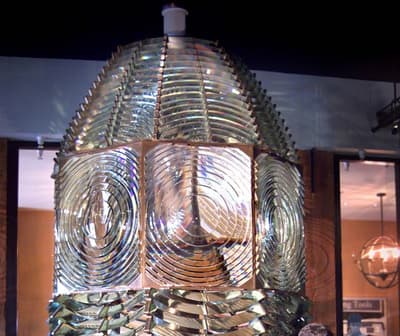
Enter Augustin Fresnel. In the early 1820s, the French physicist didn't just look at lighthouses; he looked at the behavior of light itself. He realized that traditional lenses were too thick and heavy to be practical; they absorbed too much light and were nearly impossible to rotate efficiently.
Fresnel’s solution was a stroke of mathematical genius. He designed a lens using a series of concentric rings—essentially "stepping" the glass to capture and refract light into a concentrated, horizontal beam. This "Fresnel lens" was a marvel of efficiency, turning a scattered glow into a piercing, focused spear of light. But as these lenses grew in power, they grew in scale. These weren't handheld lamps; they were massive, multi-ton assemblies of glass and brass that could weigh upwards of 6,000 pounds.
Fresnel had solved the problem of brightness, but he had inadvertently created a new problem of momentum. How do you rotate a six-ton piece of glass smoothly enough to create a perfect, rhythmic flash?
Floating on Liquid Silver
The answer arrived in 1825, and it sounded like something out of an alchemist's handbook: mercury.
Engineers realized that if they couldn't overcome friction with gears and wheels, they could simply eliminate the need for them. They developed a system where the massive lens assembly didn't sit on a pedestal or a track. Instead, it sat in a circular trough filled with liquid mercury.
The physics are staggering. Mercury is incredibly dense—about 13.5 times denser than water. Because of this extreme density, a 6,000-pound lens doesn't crush the liquid; it floats on it. By resting the lens in a "bath" of mercury, the friction of rotation was reduced to almost nothing. The heavy assembly was no longer fighting against gravity and mechanical grind; it was gliding on a liquid cushion.
This allowed even the most massive, complex lens arrays to be rotated by a relatively small clockwork mechanism. The rotation became smooth, predictable, and—most importantly—fast enough to create the distinct, rapid flashing patterns sailors needed to identify their location. The mercury flotation system turned a lumbering piece of machinery into a high-precision instrument of navigation.
A Legacy Written in Light
The impact was immediate. By providing a reliable "signature" for every lighthouse, the mercury flotation system stripped the sea of its ambiguity. A mariner could look at a flash, count the seconds between the intervals, and know with absolute certainty: "That is the Cape Hatteras light; I am ten miles off the coast."
It was a triumph of engineering that bridged the gap between brute force and delicate precision. Augustin Fresnel and the engineers who implemented his vision didn't just build better lamps; they mastered the physics of motion, ensuring that even in the darkest, heaviest storms, the light would always speak clearly to those lost at sea.
Sources
- United States Lighthouse Society: Lens Rotation and the Fresnel Legacy
- National Oceanic and Atmospheric Administration (NOAA): Historical Maritime Navigation Records
- Encyclopaedia Britannica: The Physics of Fresnel Lenses