Most zoo legends sound like the kind of story that gets better every time someone tells it. The animal gets bigger. The danger gets sharper. The hero gets cleaner, braver, more cinematic.
And then there is Gabi, whose story does not need embellishment at all.
She was not an exotic animal, not a prized attraction, not even the creature people had come to see. Gabi was a German shepherd, an eight-year-old working dog adopted by the Belgrade Zoo in the 1980s, where she became what the best guard dogs often become: part employee, part fixture, part quiet piece of infrastructure no one fully notices until the night everything depends on them.[1]
That night came on 22 June 1987.
Somewhere in the darkness of the Belgrade Zoo, a jaguar got out of its cage.[1] That fact alone is enough to change the emotional temperature of a place. A zoo is supposed to feel like controlled wildness. The danger is meant to stay behind bars, arranged for viewing, catalogued, contained. The whole institution rests on that boundary. Once the jaguar is loose, the boundary is gone, and the place stops being a zoo for a while and becomes something older and less orderly.
Gabi was out on patrol with guard Stanimir Stanić and another male German shepherd when it happened.[1] In the dark, Stanić did not notice the escaped jaguar. Gabi did.
That is the moment the story turns. Not because anyone made a speech. Not because there was a plan. But because one dog sensed what the human beside her had not yet seen and moved first.
The Dog Who Did Not Hesitate
When Gabi detected the jaguar, she leapt at it.[1] The other shepherd ran. Which, honestly, is the more understandable reaction. A jaguar is not merely a large cat. It is a compact machine built for ambush, force, and control. It is the kind of animal that turns hesitation in other creatures into opportunity.
Gabi did the opposite. She closed the distance.
What followed was not a neat confrontation in one spot. According to the source material, Gabi fought the jaguar throughout the zoo.[1] That detail matters. It means this was not one dramatic lunge and then an ending. It was a moving battle, a chaotic pursuit and resistance that kept the jaguar occupied long enough for something crucial to happen elsewhere.
While Gabi engaged the animal, Stanić was able to telephone the police, and zoo workers had time to close the exits.[1] That is the real shape of heroism in institutional settings. Not triumph in the theatrical sense, but interruption. Delay. Buying minutes. Creating just enough time for the system around you to wake up and do its job.
That is what Gabi gave them.
Why This Story Endures
Part of what makes the story stick is its reversal of expectation. In a zoo, the obvious drama is supposed to belong to the wild animals. The jaguar is the headline creature. The jaguar is the danger. The jaguar is what people cross the city to see.
And yet, when the structure broke down, it was not spectacle that saved the day. It was routine. A working dog. An older shepherd on patrol. An animal whose role was not glamour but vigilance.
Stories like this survive because they expose something people already suspect but rarely get to see this clearly: institutions do not hold together only because of their design. They hold together because of the alertness and courage of the individuals inside them. Sometimes those individuals wear uniforms. Sometimes they wear fur.
Gabi also fits a particular kind of beloved public hero, the one who does not win by emerging untouched. She was badly injured in the fight and needed stitches.[1] That makes the story feel less like folklore and more like reality. Courage here had a cost. The jaguar was not a symbolic threat. It was a real predator, and Gabi paid for confronting it.
But she survived. More than that, she made a full recovery and returned to work.[1] The story would already be memorable if it ended with the attack. It becomes something deeper because it includes recovery. She was not only brave in crisis. She resumed her ordinary life afterward.
The Strange Power of Animal Heroes
Humans have always been drawn to stories in which animals seem to act with a kind of moral clarity. Not because we think they are moral philosophers, but because they often act without the clutter that makes human behavior look compromised. There is no committee meeting in Gabi’s story. No brand management. No speech about duty. There is only perception, action, injury, survival.
That simplicity gives the story its force.
It also helps explain why Gabi did not vanish into the archive as a charming local anecdote. In Belgrade, she became famous.[1] Fame, in cases like this, is really a form of collective gratitude. A city decides that one act should not be allowed to dissolve into ordinary time. It takes a moment of danger and says: this stays.
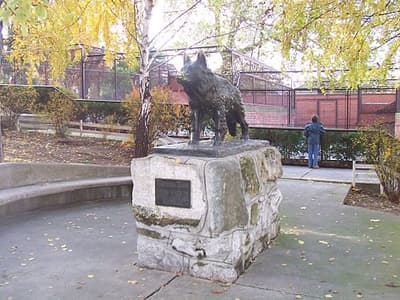
And in Gabi’s case, it did stay. Her memory was eventually fixed not just in retellings but in public space. A sculpture titled Heroic heart of Gabi was erected at the Belgrade Zoo, with an inscription that roughly means, “To Gabi, from grateful citizens.”[1] That is a remarkable afterlife for a guard dog. She did her job one night with unusual ferocity, and the city answered by turning her into a monument.
A Hero in the Wrong Spotlight, and Then the Right One
There is something almost perfect about the fact that Gabi was not the animal anyone expected to become the legend of the Belgrade Zoo. The escaped jaguar had the exotic power. Gabi had the work ethic. The jaguar had the mythic silhouette. Gabi had the patrol route.
But when the line between enclosure and emergency collapsed, it was the ordinary animal, the familiar one, the dog doing security rounds in the dark, who became the center of the story.
That may be the deepest reason people still remember her. Gabi’s story flatters an intuition most of us want to believe: that courage is often hiding in the background, disguised as reliability, until the moment comes when reliability turns out to be exactly what heroism looks like.
On 22 June 1987, a jaguar escaped into the night at the Belgrade Zoo.[1] It could have become a story about catastrophe, panic, or failure. Instead, it became a story about a German shepherd who saw the danger first, fought it across the zoo, survived her injuries, returned to work, and was remembered not as a mascot or curiosity, but as what she had been when it mattered most.
A guard dog.