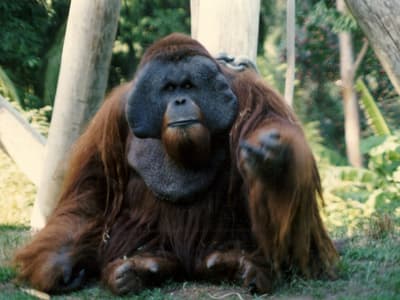
Most zoo escape stories follow the same pattern. There is panic, there are sirens, there is the sudden realization that a wild animal is somewhere it is not supposed to be. Ken Allen's story was different.
When the Bornean orangutan slipped out of his enclosure at the San Diego Zoo, he did not charge at people. He did not attack keepers. He did not turn himself into a headline by behaving like a monster. He mostly wandered the zoo, calmly looking at other animals, as if he were simply a dissatisfied guest inspecting the rest of the property.[1]
That was part of what made him unforgettable. The other part was that he kept doing it.
The Orangutan Who Made a Fool of the Exhibit
Ken Allen was born at the San Diego Zoo on February 13, 1971.[1] He was a Bornean orangutan, and from the beginning there were hints that he was not built for confinement in any ordinary sense. According to later accounts, even as a youngster he would unscrew nuts and remove bolts in the zoo nursery.[1] Some animals test boundaries. Ken Allen seemed to study them.
By 1985, he had become something close to an institutional embarrassment. The zoo believed his enclosure was escape-proof. Ken Allen disagreed. On June 13, July 29, and August 13 of that year, he got out anyway.[1]
This is the point where many stories would turn dark. Instead, Ken Allen became famous for the calmness of his jailbreaks. During his escapes, he strolled around the zoo peacefully, looking at other animals. He never acted violently or aggressively toward zoo visitors or other animals, with one notable exception: another orangutan named Otis, whom he reportedly despised.[1]
A Fugitive With Excellent Public Relations
The public adored him almost immediately. Ken Allen was nicknamed "The Hairy Houdini."[1] He attracted worldwide attention. He inspired T-shirts and bumper stickers, many of them reading Free Ken Allen.[1] He even had his own fan club.
It is not hard to see why. There was something irresistibly human about the whole thing, not in the sentimental sense, but in a more unsettling one. He seemed to have preferences, plans, timing, and an eye for weakness. He was not merely stronger than the system. He appeared to be smarter than it.
Zoos are built around the premise that the line between exhibit and observer is fixed. Ken Allen turned that line into a suggestion.
The Keepers Started Watching, and He Noticed
At first, zookeepers could not figure out how he was doing it.[1] So they set up surveillance. That sounds straightforward until you reach the unnerving detail: Ken Allen seemed to know he was being watched. Before his August 13 escape, he was reportedly seen with a crowbar in his enclosure, then tossed it aside when a staff member walked by, as though suddenly uninterested.[1]
That detail lifts the story out of ordinary zoo folklore and into something stranger. It suggests theater. Misdirection. A performance of innocence.
The staff eventually tried going undercover, posing as tourists so they could learn his escape route.[1] It did not work. Ken Allen was not fooled. He adjusted. The humans changed tactics. The orangutan changed faster.
He Was Not Alone for Long
During some of his escapes, his female companions joined him.[1] Later, other orangutans also followed his lead and escaped.[1] This is one of the most interesting parts of the story, because it shifts Ken Allen from mere escape artist to something closer to a cultural force. He was not just getting out. He was changing the behavioral atmosphere around him.
That possibility has always made his story feel larger than a string of amusing incidents. A single animal escaping is one thing. An animal teaching the system that it can be beaten, and perhaps teaching others the same lesson, is another.
The Zoo Fought Back
After each escape, Ken Allen was placed in solitary confinement while staff tried to figure out how to stop the next one.[1] The zoo added obstacles. It used surveillance. It dealt with repeated attempts, including one in 1986 that involved electrical fencing.[1] At one point, when a moat in the enclosure was being repaired in April 1986, Ken Allen got out again.[1]
Eventually, in 1987, zoo officials hired experienced rock climbers to inspect the exhibit and identify every possible fingerhold and foothold. The zoo spent $40,000 eliminating them.[1]
That detail captures the scale of the mismatch. The institution had to bring in professional climbers to think like the orangutan.
The Rare Moment of Violence
Ken Allen's docility during his escapes is central to his legend, but it was not absolute. During his third 1985 escape, he was caught throwing stones at Otis and had to be led back to his enclosure. Afterward, the zoo temporarily placed him in solitary confinement.[1]
That moment matters not because it makes him less remarkable, but because it makes him more specific. He was not a cuddly symbol of freedom. He was an orangutan with his own grudges, his own temper, his own opinions about who deserved his attention and who deserved a rock.
Why Ken Allen Endured
Ken Allen died on December 1, 2000, at age 29, after developing B-cell lymphoma. He was euthanized.[1] By then, he had already become something rare in zoo history: not just a well-known animal, but a local legend who had slipped into popular culture.
Part of that was timing. Part was the comic elegance of the escapes. But the deeper reason is that Ken Allen exposed a tension people already felt but rarely articulated. We build enclosures to prove control. Then an orangutan strolls out, glances at the zebras, and reminds everyone that intelligence does not stop at the edge of the human species.
He did not terrorize the zoo. He embarrassed it, calmly, repeatedly, and somehow that made the story even better.
In 2013, Time listed his case among the top zoo escapes.[1] But even that almost undersells it. Ken Allen was not memorable simply because he escaped. Plenty of animals have escaped. He was memorable because he escaped like someone who had already thought more carefully about the problem than the people in charge.