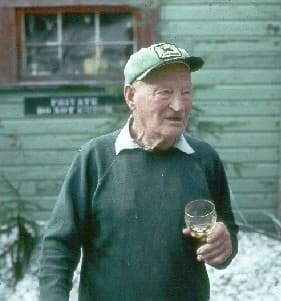
Most people become famous for one thing. Harry R. Truman became famous for refusing to leave a volcano that was plainly trying to kill him. But by the time Mount St. Helens erupted in 1980, the old man at Spirit Lake had already lived several lives, each one stranger than the last.
He had been on a troop transport sunk by a German U-boat during World War I.[1] He had bootlegged alcohol during Prohibition.[1] He had reportedly thrown his ex-wife into a lake during arguments.[1] He had gotten park rangers drunk, impersonated game wardens, assaulted tax officials, and driven off visitors he disliked, including, according to local lore, Supreme Court Justice William O. Douglas.[1] He hated hippies, loved his mountain, and when the end finally came, he stayed on the volcano with his cats.[1]
That is too much personality for a novel, which is perhaps why Truman became a kind of American folk character in real time. He was not admirable in any clean, civic way. He was abrasive, theatrical, often violent, and almost aggressively unmanageable. But when a mountain told everyone to run and Harry Truman said no, the country could not stop watching.
The Man Before the Mountain
Harry R. Truman was born in October 1896 and spent parts of his early life in Washington and West Virginia before drifting into the kind of rugged, improvised adulthood that now feels nearly extinct.[1] He served in World War I as an Army Air Service mechanic and was aboard a troop transport that was sunk by a German U-boat.[1] Even by the standards of his generation, that is the sort of experience that hardens into a story a man tells himself for the rest of his life.
And Truman did seem to build himself out of accumulated survivals. After the war he worked a string of jobs and developed the taste for risk, drink, and defiance that would define him. During Prohibition, he ran liquor.[1] At various points he prospected, ran businesses, and cultivated the sort of frontier-lawless charisma that can look, depending on your distance, like either freedom or menace.
Some people soften with age. Truman seems to have done the opposite. He became more himself, not less.
Spirit Lake and the Invention of Harry Truman
In 1929, Truman bought land at Spirit Lake near Mount St. Helens and eventually operated the Mount St. Helens Lodge there.[1] This was not merely a business address. It became the stage on which his legend was performed. He ran the lodge for decades, greeted tourists, quarreled with officials, drank heavily, and turned rudeness into a kind of personal brand before America really had language for personal brands.
He loved the mountain with the possessiveness of someone who believes landscape can become biography. St. Helens was not scenery to him. It was home, identity, proof that he belonged somewhere more durable than other people did. That matters, because when the mountain later began to wake up, the evacuation orders were asking him to leave more than property. They were asking him to leave the place in which he had turned himself into Harry Truman.
By then he had already built a reputation for volatility. Accounts from friends and locals described a man who could be charming one minute and ferocious the next.[1] He reportedly threw one of his wives into Spirit Lake during an argument.[1] He feuded with tax men and once assaulted Internal Revenue agents.[1] He impersonated officials, antagonized authorities, and viewed rules less as obligations than as insults.[1]
A Professional Enemy of Politeness
What made Truman memorable was not just that he was difficult. It was the extravagance of the difficulty. He got park rangers drunk.[1] He disliked outsiders. He particularly disliked hippies, whom he treated less as a social group than as a civilizational collapse in human form.[1] He threatened, blustered, cursed, and performed outrage so consistently that it became hard to tell where genuine temperament ended and cultivated persona began.
Even his stories about driving people off took on a mythic quality. The tale that he chased away Justice William O. Douglas belongs to that category, local enough to feel true, theatrical enough to become immortal whether or not every detail survived intact.[1] Truman lived in a way that generated folklore as a byproduct.
That is one reason the media loved him in 1980. They did not merely find a holdout on a volcano. They found the perfect holdout, a profane, stubborn, camera-ready old man with a mountain behind him and contempt for authority in every sentence.
When the Volcano Started Talking
In the spring of 1980, Mount St. Helens began to show unmistakable signs of eruption. Earthquakes rattled the region. Steam blasted from the summit. Officials drew evacuation zones around the mountain and told people to leave.[1] Truman refused.
He was in his eighties by then, living at the lodge with a cluster of cats, and he treated the warnings with derision.[1] He told reporters that the mountain and he understood each other. He insisted the danger was exaggerated. He became, almost overnight, the human face of refusal.
It is easy now to treat that refusal as quaint or noble, depending on your taste for Americana. It was neither. It was more complicated than that. Truman was not making a principled stand in the abstract. He was doing what he had always done: rejecting outside authority, clinging to his own judgment, and trusting personality over institution. The volcano simply gave that tendency its most dramatic stage.
Children wrote him letters. Reporters flocked to him. Souvenirs appeared. He became famous because everyone sensed, correctly, that this was either going to become a story about eccentric courage or a story about fatal delusion, and perhaps those two things are never as far apart as people like to imagine.
The Eruption
On May 18, 1980, Mount St. Helens erupted catastrophically.[1] The north flank collapsed, the lateral blast tore across the landscape, and the area around Spirit Lake was devastated. Truman did not survive. He is presumed to have been killed when a pyroclastic flow overwhelmed his lodge and buried the site under roughly 150 feet of volcanic debris.[1] His body was never recovered.[1]
And that, in a bleak way, completed the legend. Harry Truman had spent weeks telling the world he would not leave. Then the mountain erupted, and he did not. He died as he had lived, stubbornly, theatrically, and beyond retrieval.
There is something unusually American about the shape of that ending. A man spends a lifetime resisting regulation, taxes, officials, manners, geography, spouses, and probability itself, and in the end the thing that kills him is not government or war or drink, but geology. Not argument, not ideology, not even age. A mountain.
Why He Endures
After his death, Truman was remembered not as a tidy hero but as a folk hero, which is a different thing entirely.[1] Folk heroes do not need to be good. They need to be vivid. They need to embody some trait a culture half admires and half fears. Truman embodied refusal, total, unapologetic refusal. He would not leave the mountain. He would not become reasonable. He would not become smaller to fit other people's expectations.
That is why the list of details about his life keeps circulating. The U-boat. The bootlegging. The lake. The tax men. The rangers. The hippies. The justice. The cats. Each fact adds another layer to the same portrait: a man who treated civilization as a set of suggestions and spent his life answering to a rougher code of his own invention.
It would be easy to sentimentalize him. Better not to. Harry R. Truman was not some sage of the wilderness. He was a difficult, unruly, self-dramatizing man who happened to collide with one of the most famous natural disasters in modern American history. But because he collided with it so completely, because he refused to step aside even at the edge of annihilation, he became something larger than himself.
He became the kind of figure people tell stories about when they want to talk about defiance without having to sort too carefully through its consequences.