Ernest Hemingway spent World War II doing something that sounds less like history than like a man trying to out-Hemingway himself.
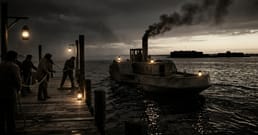
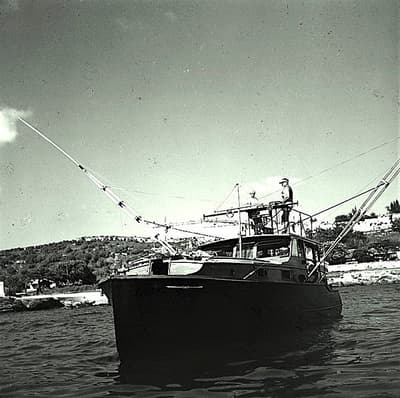
He took his fishing boat, Pilar, named for the nickname of his second wife Pauline, armed it with Thompson submachine guns and hand grenades, and went looking for German U-boats in the Caribbean.[1] The U.S. government, astonishingly, gave him unlimited gasoline for the effort.[1] This was not a Navy destroyer. It was a 38-foot fishing boat bought in 1934 for $7,495, a vessel better suited to marlin than submarine warfare.[1] And yet, for part of the war, Hemingway treated it as both.
The plan, to the extent that it can be called a plan, had the peculiar logic of a Hemingway story. Pilar would cruise the waters off Cuba under the appearance of an ordinary fishing expedition.[1] If a German submarine surfaced nearby, Hemingway and his crew would close in under the guise of harmlessness, then attack at short range with whatever weapons they had on board.[1] It was part spy fantasy, part private war, and entirely in character.
A Boat Built for Fish, Not Fascists
Pilar was not originally a weapon. Hemingway bought the boat from Wheeler Shipbuilding in Brooklyn in April 1934, and for years it was central to his life as a sportsman and writer.[1] He fished from it in the waters around Key West, the Marquesas Keys, the Gulf Stream, and off the Cuban coast.[1] He took it to Bimini. He drank on it, fought on it, and turned it into part of his legend.[1]
The name itself carried more than one meaning. “Pilar” was Pauline Hemingway's nickname, but it was also the name of the formidable guerrilla woman in For Whom the Bell Tolls.[1] Even before the wartime patrols, the boat already sat at the intersection of Hemingway's personal life, his fiction, and his appetite for turning experience into myth.
That is part of what makes the wartime transformation of Pilar so revealing. Hemingway did not go out and acquire some special military craft. He militarized the boat that was already an extension of himself. The yacht became another version of the man, only with more ammunition.
The Caribbean Turns Dangerous
The scheme was not dreamed up in a vacuum. German U-boats really were operating in the Caribbean during World War II, threatening shipping lanes and making the region part of the wider Battle of the Atlantic.[1] Cuba mattered. The sea lanes mattered. Oil, cargo, troop movement, all of it mattered. And in wartime, even outlandish ideas can start sounding plausible when the enemy is genuinely nearby.
So Hemingway, living in Cuba and already well connected, became involved in anti-submarine patrol efforts.[1] He turned Pilar into a quasi-military vessel, loaded it with small arms and explosives, and took to the water looking for German submarines.[1] The U.S. ambassador in Cuba, Spruille Braden, supported the operation, and the U.S. government supplied the fuel.[1]
That detail, the unlimited gasoline, tells you something about how wartime governments sometimes behave around famous men. Hemingway was not just another volunteer with a hobby. He was Ernest Hemingway, globally famous, politically useful, and persuasive in the way very self-confident celebrities often are. Bureaucracies that might have laughed ordinary people out of the room sometimes made room for Hemingway's improvisations.
The Anti-Submarine Plan That Barely Made Sense
The operational idea was simple enough to explain and absurd enough to be memorable. Hemingway and his crew would pretend to be harmless fishermen if they encountered a submarine on the surface.[1] Once close enough, they would open fire and throw grenades.[1] This was not exactly naval doctrine. It was more like ambush theory adapted for one famous novelist, one fishing boat, and one nearly impossible target.
And yet it contained a certain rough wartime logic. German submarine crews did sometimes surface. Surprise matters in combat. Civilian-looking craft can get closer than warships. If you squint at the plan just right, it almost works in outline. Then you remember the scale mismatch. A submarine is a submarine. A fishing boat is a fishing boat. Hemingway's plan required courage, luck, proximity, and an enemy willing to make several mistakes in sequence.
It also required Hemingway to imagine himself not merely as an observer of war, but as an active participant in it. That may be the key to the whole episode. Hemingway had covered war, written war, mythologized war. Pilar's submarine patrols let him inhabit war in a way that collapsed the distance between novelist, correspondent, and combatant.
What Actually Happened
What did not happen is almost as important as what did. Hemingway never sank a U-boat with Pilar.[1] The patrols produced excitement, stories, and reinforcement of his legend, but not the kind of combat success the plan implied.[1] No dramatic showdown delivered the ending the setup seems to promise.
That anticlimax matters because it separates the romance from the reality. Wartime improvisation can be brave and ludicrous at the same time. Hemingway's patrols were not meaningless, exactly, but neither were they the decisive anti-submarine campaign that the image of a grenade-armed writer in the Caribbean invites you to imagine.
And maybe that is why the story survives so well. It is not remembered because it changed the war. It is remembered because it perfectly captures a certain kind of twentieth-century masculinity, adventurous, theatrical, competent enough to be dangerous, and irresistibly drawn toward the edge where real action and self-invention meet.
Why It Sounds So Much Like Hemingway
Almost every detail feels prewritten for posterity. The famous author. The fishing boat named Pilar. The Caribbean heat. The Thompson guns. The hand grenades. The German submarines somewhere beyond the horizon. Even the government's role, supplying unlimited fuel, has the faintly comic grandeur of a world willing to subsidize Hemingway's personal war.[1]
But beneath the flamboyance is something more revealing. Hemingway was always drawn to activities that let him test whether his style of life could hold up under pressure. Big-game hunting. Bullfighting. Deep-sea fishing. War. Pilar had already been one stage for that performance. During World War II, it became another.
The boat endured beyond the patrols. It remains one of the most famous literary vessels in modern history, preserved at Hemingway's home outside Havana.[1] That feels right. Pilar was never merely transportation. It was part workshop, part theater, part evidence that Hemingway preferred to build his mythology out of actual objects that smelled of salt, fuel, fish, and danger.
So yes, during World War II Ernest Hemingway really did go U-boat hunting in the Caribbean with a fishing boat named Pilar, armed with Thompson guns and grenades, and fueled by the U.S. government.[1] It was impractical. It was improbable. It achieved little in military terms. And it may be one of the most perfectly Hemingway things Ernest Hemingway ever did.