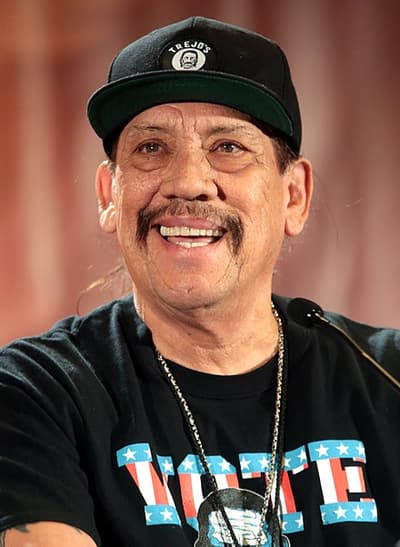
Danny Trejo has spent decades playing men you would not want to meet in a dark alley. Killers. Gangsters. Inmates. Human warning labels with tattoos. Hollywood looked at his face and understood the assignment immediately.
But Trejo has his own rule for what happens next. If the bad guy lives, gets away with it, and rides off with the girl, he is not interested. “The bad guy’s got to die or go to prison,” he said, because he wants young people to understand something he learned the hard way: crime does not pay, and the life that looks dangerous and glamorous from a distance usually ends in a cage, a coffin, or both.[1][2]
That rule only makes sense once you know who Danny Trejo was before he became Danny Trejo.
Before Hollywood, There Was Prison
Trejo was born in 1944 in Maywood, California, and raised in Los Angeles. By his own account, drugs entered his life absurdly early. He was using marijuana as a child, heroin by 12, and cocaine by 18. He was first arrested at 10. The 1960s disappeared into California’s prison system, where he did time in places like San Quentin, Folsom, Soledad, and Vacaville.[1]
This is the part where many celebrity biographies reach for a neat redemptive arc. Trejo’s story is messier than that. In prison, he was not a misunderstood artist waiting to be discovered. He was deep in a life of addiction, violence, and survival. He boxed seriously while incarcerated and became champion in San Quentin’s lightweight and welterweight divisions. During a riot at Soledad, he ended up in solitary confinement facing devastating consequences after striking a guard with a rock.[1]
And somewhere inside that world, he changed.
Trejo later said he found faith in solitary confinement and committed himself to sobriety. He was released in 1969 and has said he remained sober from that point on. That detail matters because it explains the rest of the story. Trejo did not simply leave prison. He built his whole second life in opposition to the first.[1]
The Face Hollywood Could Not Ignore
His movie career did not begin with an audition in the usual sense. It began because Trejo, now sober, was working as a substance abuse counselor and got called to help someone with cocaine problems on the set of Runaway Train in 1985. While he was there, screenwriter Edward Bunker recognized him from San Quentin, remembered his boxing ability, and helped get him work, first as a boxing trainer and then as an on-screen presence.[1]
Hollywood, naturally, knew exactly what to do with him. Trejo’s lined face, prison tattoos, and palpable menace made him instantly believable as inmates, enforcers, gangsters, and assorted hard men. For years he was the actor brought in to make a scene feel dangerous. He showed up in films like Desperado, Heat, From Dusk till Dawn, and Con Air, often playing some variation of the same threat in a different shirt.[1]
But there is a difference between being typecast and being trapped. Trejo found a way to turn those roles into a message.
Why the Villain Has to Lose
In a 2020 interview, Trejo explained his logic with characteristic bluntness. If filmmakers want him to play the bad guy and that bad guy lives and gets the girl, he refuses. The bad guy has to die or go to prison. This was not some quirky contract clause built for publicity. It was moral instruction, aimed especially at young people who confuse notoriety with power.[2]
Trejo still speaks to juvenile offenders and young audiences about addiction, prison, and consequence. He tells them he has “never known a successful drug dealer.” The examples people reach for, the glamorous criminals, the untouchable kings, always collapse under scrutiny. They are dead, locked up, or running on borrowed time.[2]
That is what makes the Trejo persona more interesting than it first appears. On screen, he often embodies criminality. Off screen, he argues against its mythology. He plays the outlaw, but he does not romanticize the outcome. In a culture that often turns bad men into folk heroes, that is a surprisingly disciplined line to hold.
The Strange Second Act
Then came the twist Hollywood never could have scripted better. The former inmate who spent years playing background menace became something close to a beloved institution. Robert Rodriguez helped turn him into an icon through roles in Spy Kids and, later, Machete. Children who first knew him as the knife-wielding Uncle Machete grew up to recognize the same man from grittier films their parents probably should not have let them watch.[1]
Trejo’s career expanded in every direction: film, television, voice acting, commercials, even restaurants. But the deeper point is not that he became famous. It is that he became useful. He kept working as a substance abuse counselor. He returned to prisons to talk to inmates. He helped hand out food and supplies in his community. In 2019, he even helped rescue a child trapped in an overturned SUV after a crash in Los Angeles.[1]
So the face that once signaled danger began to signal something else: survival with purpose.
What Danny Trejo Is Really Selling
The easy version of Danny Trejo’s life is that he went from convict to movie star. The more interesting version is that he never forgot what the first half was for. He understands better than most actors what young people can misunderstand about toughness. He has lived the part that movies often polish into fantasy. He knows what jail smells like, what addiction costs, and how quickly the glamorous outlaw story curdles into something smaller and uglier.
That is why his rule matters. It sounds like a tiny note in a contract. In reality, it is a worldview. Let the villain be charismatic if you want. Let him be funny, memorable, even magnetic. But do not let him be rewarded. Not when there are kids watching. Not when Trejo knows exactly where that story goes.[2]
Which means Danny Trejo may have spent his career playing bad guys, but the point was never to make them admirable. It was to make their ending unmistakable, and to leave younger audiences with a simple idea that took him years of prison, addiction, and recovery to earn: try to live a decent life, because the other one is a trap.[1][2]
Sources
[2] NME: Danny Trejo: “The Beatles’ ‘Hey Jude’ started a riot when I was in prison”