If you want to understand how clever urban animals can become, do not start in the forest. Start on a Moscow sidewalk. Watch a loose pack of stray dogs approach a group of humans with something close to calculation. The biggest dog does not always go first. Sometimes the opposite happens. The pack seems to send in the smallest, softest-looking, most harmless member to make the appeal.
And according to researchers who studied Moscow’s stray dogs, that may not be sentimental projection at all. It may be strategy. In a city with thousands of stray dogs competing for scraps, some appear to have learned that people are more likely to feed the animal that looks young, approachable, and a little vulnerable.[1]
The City That Made Smarter Strays
Moscow has had an enormous stray-dog population for decades. Estimates cited by ABC News in 2010 put the number as high as 35,000.[1] That matters, because once you have that many dogs living not on the margins of a city but inside it, surviving off it and adapting to it, you no longer have just “wild” animals. You have a parallel urban culture.
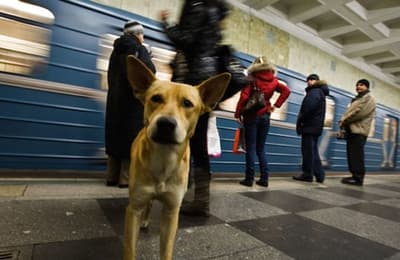
These dogs are not simply wandering. They are learning. They navigate crowded streets, busy plazas and, famously, the Moscow Metro. Some ride trains on their own, get off at familiar stops, and move through the system with the kind of practical competence that would be impressive in a distracted tourist, let alone a stray dog.[1]
That is the first important correction. The popular image of a stray dog is usually one of desperation. But Moscow’s dogs have often been described by observers as something more unsettling and more interesting: specialists. They are surviving in one of the largest cities in Europe by becoming students of human behavior.
What They Seem to Have Figured Out
One of the researchers quoted in the ABC report, biologist Andrey Poyarkov, described the dogs as highly skilled readers of people.[1] They do not interact with every human in the same way. They appear to make distinctions. They notice tone. They notice routine. They notice who is likely to ignore them and who might hand over food.
And this is where the smaller, cuter dog becomes important. If a pack is trying to get fed, sending the largest, roughest-looking animal forward may be the worst possible move. Humans do not just respond to need. They respond to presentation. A compact dog with softer features may trigger sympathy in a way a scarred, dominant-looking adult does not.
The implication is fascinating. These dogs may not merely be begging. They may be managing impressions. They may have learned, through repeated trial and error, that one kind of dog produces one kind of human reaction, while another produces a different one. If that is true, then what looks like random scavenging is actually role assignment.
The Subway Detail Changes the Story
The Metro is what makes the whole thing harder to dismiss as anecdote. A dog that can use a subway system is not operating on simple instinct. According to the ABC report, some Moscow strays seem to understand routes well enough to travel between sleeping areas and feeding areas by train, boarding and exiting at the right stops.[1]
That matters because it suggests layers of cognition. First, a dog has to tolerate the noise, crowds, and movement of the station. Then it has to recognize a destination. Then it has to associate particular places with particular rewards. That is not the behavior of an animal merely reacting to the moment. That is an animal building a map.
Once you accept that, the “cute delegate” theory stops sounding so fanciful. If a dog can learn the subway, it can probably learn that humans are easier to persuade when approached by the least threatening member of the group.
Why Cuteness Works on Humans
There is a reason this tactic would work. Humans are highly sensitive to cues of youth and harmlessness. Large eyes, small body size, hesitant posture, a softer face, these things reliably trigger caretaking instincts. We like to imagine our kindness is rational. Often it is visual.
Moscow’s dogs, if researchers are right, may have stumbled onto one of the most important rules of living near people: human beings feed stories, not just stomachs. A big dog walking straight toward you can register as danger. A smaller dog hanging back, looking hopeful, registers as a plea.
That difference can decide who eats.
Not Just Smart, but Socially Smart
There is a deeper point here. Animal intelligence is often discussed as if it were mostly about puzzles. Can the crow bend the wire? Can the chimp stack the boxes? But urban intelligence may look different. It may be less about objects and more about society. Who has power. Who is generous. Who can be manipulated. Which face gets the food.
That kind of intelligence is especially striking in pack animals. A dog does not merely have to understand people. It may also have to understand its own group well enough to know which member is best suited for which role. The bold one confronts threats. The experienced one leads movement. The cute one gets fed.
If that sounds uncomfortably familiar, it should. Human groups do versions of this all the time.
The Real Surprise
The surprising thing is not that stray dogs in Moscow became opportunistic. Of course they did. The surprising thing is how refined that opportunism appears to be. These are not just animals hanging around train stations hoping for luck. They may be reading a megacity the way commuters do, identifying routes, routines, and emotional weak spots in the species that built it.[1]
Which means the title is not really about cuteness. It is about adaptation. Put thousands of dogs into a giant, crowded, indifferent city, and the ones that survive will not necessarily be the strongest. They may be the best psychologists.
And somewhere in Moscow, if observers are right, that may mean a scruffy little dog walking forward while the larger ones hang back, because the pack has already learned what humans still do not like to admit about themselves: we are easiest to persuade when we think we are simply being kind.
Sources
1. ABC News - Stray Dogs Master Complex Moscow Subway System