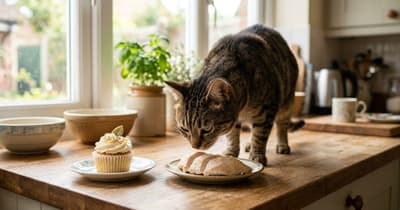
A cat can sit inches from a cupcake and miss the whole point. The butter might interest it. The cream might get a sniff. But the sweetness, the thing humans built the dessert around, does not arrive in a cat's brain the way it arrives in yours.[1]
The reason is not attitude. It is wiring. In mammals that taste sugar, sweetness depends on a receptor built from two partner proteins, T1R2 and T1R3, encoded by the genes Tas1r2 and Tas1r3.[2] In domestic cats, researchers found that Tas1r2 carries a deletion that keeps it from making a working sweet receptor. The gene is still visible in the genome, but it behaves like a broken instruction page in the recipe book.[2]
That helps explain an old kitchen mystery. Cats are famously picky, but experiments had already shown that they do not seek out sweet carbohydrates or sweeteners the way many other animals do.[2] Scientific American summarized the genetic clue neatly: cats are missing 247 base pairs in the DNA sequence of Tas1r2, enough to turn the sweet-taste gene into a pseudogene rather than a functioning part of the taste system.[3]
This fits the cat's larger life story. Cats are obligate carnivores, animals built to get their nutrients from prey rather than from fruit, grain, or nectar.[1] For a creature whose natural menu is meat, sugar is not the same bright nutritional signal it is for many omnivores and herbivores. A mouse does not need to taste like dessert to be worth chasing.
The odd part is how selective the loss is. Cats are not taste-blind. They can respond to bitter, salty, sour, and savory cues, and Cornell notes that feline diets still need careful balance because cats have specialized nutritional requirements.[1] The missing sense is narrower and stranger: one familiar pleasure channel, so powerful in human food culture, simply does not work for them.
That does not mean a cat will never lick frosting or nose around ice cream. Fat, texture, temperature, and smell can all make human food interesting. But if your cat steals a bite of something sweet, it is probably not chasing the sugar rush you imagine. It is living in a sensory world next to ours, close enough to share the kitchen, different enough that the cupcake is almost a different object.
The small broken gene is a reminder that taste is not universal. Every animal eats through a body shaped by its own history. Humans made sweetness a comfort, a reward, even a weakness. Cats walked away from it long before the bakery opened.