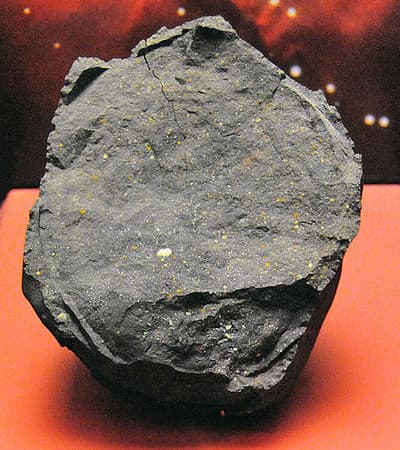
At 10:58 on the morning of 28 September 1969, a series of loud booms stopped the town of Murchison, Victoria, and sent residents outside to look at the sky [3][4]. It was a spring Sunday, and many people were on their way to church when a bright fireball broke into three fragments and vanished, leaving a trail of smoke [2][4]. About thirty seconds later, a tremor rolled through the district [2].
Fragments came down across farmland rather than in a single crater [3], scattered over an area larger than 13 square kilometres [2]. Individual stones reached 7 kilograms, and one piece weighing 680 grams punched through a roof and landed in hay [2]. Collectors eventually recovered more than 100 kilograms of material [2].
The day after the fall, a local farmer named Arnold Brisbane carried samples into his local newspaper, which contacted the University of Melbourne [3]. Scientists reached the strewn field while the stones were still fresh and uncontaminated [3]. That timing, together with the mass of the fall and the fact that it was observed, has made Murchison one of the most studied meteorites in the world [2].
Murchison is a carbonaceous chondrite of the CM2 group, with a composition of 22.13 percent total iron and about 12 percent water [2]. It belongs to a group of meteorites rich in organic compounds, and its organic content has drawn researchers for half a century [2][4]. Work on the sample has traced carbon chemistry elsewhere in the universe and probed how the elements formed [3].
The organic compounds in Murchison include amino acids, and their presence in a stone older than Earth has been read as evidence that the raw materials of life are common in the cosmos [2][3]. Chemistry offers a way to judge whether such molecules were made by biology or by simpler reactions. In 1952, Stanley Miller, working under Harold Urey at the University of Chicago, ran methane, ammonia, hydrogen and water through an electric arc and produced amino acids from inorganic starting materials [1]. Prebiotic experiments since then have continued to yield racemic mixtures of organic compounds, including amino acids, under a wide range of conditions [1].
In January 2020, cosmochemists reported that silicon carbide grains from Murchison are the oldest material found on Earth, dated to about 7 billion years, roughly 2.5 billion years older than the Earth and the Solar System [2]. The same study cautioned that dust lifetime estimates depend on theoretical models built for smaller, more common grains and carry large uncertainties [2].
Marianne Begg was getting her children ready for the 11 o'clock church service when she heard three booms and saw a puff of blue smoke in a clear sky, and the air smelled strongly of methylated spirits [4]. Her dairy herd bunched into a corner of the paddock with their ears up [4]. Neighbours guessed at a burst vat, a plane crash, a gas explosion or guns firing at the Puckapunyal training base, and in 1969 there was no quick way to check [4].
The stone itself is about 4.6 billion years old, older than the Earth [3][4]. Its fragments have supplied evidence of carbon elsewhere in the universe, information about how elements formed, and a long-running case that the building blocks of life are plentiful beyond Earth [3].