At the 1889 Exposition Universelle in Paris, a small Czech stall displayed a pencil from the Hardtmuth company of České Budějovice, coated in a glossy yellow lacquer [6]. The firm, founded in the late 18th century by the Austrian inventor Joseph Hardtmuth, had patented a lead made from a kaolin and graphite mix and came to the fair to show it off [6]. The yellow finish was a deliberate choice rather than a decorative one [6][9].
Hardtmuth sold the pencil as the Koh-i-Noor Hardtmuth, borrowing the name of one of the world's largest diamonds, which had been incorporated into the British Crown Jewels forty years earlier [6]. The name promised diamond-grade quality; the paint promised something else [6]. The barrel carried 14 coats of yellow lacquer with gold-painted tips [5]. When the Paris exposition returned in 1900, the Koh-i-Noor Hardtmuth 1500 took a Grand Prix [6].
In imperial China, yellow was the emperor's color [3]. It was one of five cardinal colors in the wuxing system, corresponding to earth, and the saying "yellow generates yin and yang" places it at the center of things [3]. Bright yellow could be worn only by the emperor and his household, and the Qing dynasty flag used golden yellow as its background [3][4]. A pencil maker who chose that color was borrowing a signal of rank [5].
China is the world's largest export source of mined graphite by tonnage [2], and 19th-century manufacturers treated Chinese graphite as the finest available [7][10]. Hardtmuth's own stock was credited to a large deposit in the Sayan Mountains of Siberia, close to the Chinese border [9]. A yellow barrel told a buyer the carbon inside came from that part of the world [7][9].
American manufacturers began painting their pencils bright yellow to tell customers the graphite was Chinese and to borrow the regal feeling the color carried in China [7]. Rivals copied the paint and reached for Asian-sounding names, selling pencils as "Mongol" and "Mikado" [5]. Henry Petroski's history of the pencil credits the European Koh-I-Noor with getting there first [7].
Before the 1880s, most pencils were sold as bare wood or given a dark stain, a finish that hid imperfections in the timber [8][9]. The casing itself is thin wood, usually hexagonal in section [1], and it was that barrel that received the paint. A bright yellow finish was flashy where a dark stain was not [8].
German and Brazilian pencils are often green, blue or black, following Faber-Castell's brand colors, while southern European makers favor dark red or black barrels with yellow bands [5]. Australian pencils are typically red with black stripes, and British shoppers are more likely to find red or black than yellow [5][8].
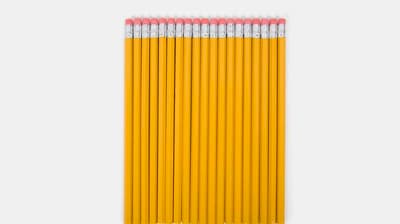
About 75 percent of the 2.8 billion pencils made in the United States each year are painted yellow [5], and most basic hexagonal graphite pencils on American shelves are yellow [7]. The paint that once advertised imperial graphite now marks the plainest pencil in the cup [5][7].