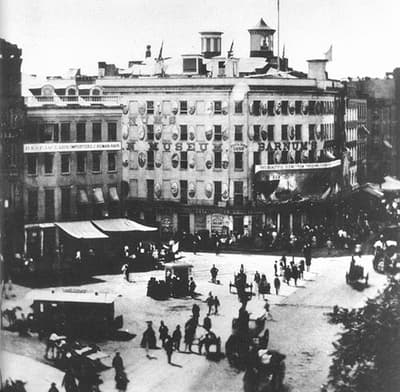
In 1841 P. T. Barnum purchased Scudder's American Museum at Broadway and Ann Street in New York City and renamed it Barnum's American Museum [3]. He added exhibits to the collection, and the showplace became one of the most popular in the United States [3]. The purchase followed a period of failure for Barnum, who had already worked as a storekeeper, newspaper editor, and showman [3]. The museum gave him a permanent New York stage for the promotional style that made him famous for hoaxes and later for the circus that bore his name [1].
By 1842 the museum scored a hit with Charles Stratton, the dwarf billed as General Tom Thumb, and with the Feejee Mermaid, which Barnum exhibited with Boston counterpart Moses Kimball [3]. Its collection also included the original Siamese twins, Chang and Eng Bunker [3]. In 1843 Barnum hired the Native American dancer Do-Hum-Me, adding a live performer to the museum's mix of curiosities [3]. These attractions helped make the museum a popular showplace rather than a quiet hall of specimens [3].
In 1865 Barnum published Humbugs of the World and used it to defend the glittering appearances and novel expedients that had filled his museum [4]. He wrote that a humbug consisted of putting on outside show to arrest public attention, and he argued that such showmanship was justified when customers felt they got their money's worth [4]. The museum gave him a steady outlet for that philosophy, with exhibits marketed to a public hungry for mass entertainment [4].
Signs inside the museum sent visitors toward an exit labeled 'This Way to the Egress' [2]. Barnum knew that many visitors would follow the signs without knowing that 'egress' meant exit [2]. Those who passed through found themselves outside and could not re-enter without paying the admission fee again [2]. The trick turned a crowd's curiosity into a faster turnover of paying customers [2].
Barnum retired from show business in 1855 but returned as a showman and museum proprietor in 1857 after settling with creditors [3]. The museum's run at Broadway and Ann Street ended on July 13, 1865, when fire destroyed the building [3]. Barnum quickly reestablished the museum at another location in New York City, but fire destroyed that site in March 1868 [3]. He later established a circus in Brooklyn in 1871 with William Cameron Coup [3].
Barnum was 61 years old when the circus collaboration was presented to him, and his long love of the American Museum had already driven his marketing machine [5]. The Barnum Museum in Bridgeport, Connecticut, notes that his influence reached American business, media, entertainment, and culture [5]. The New York museum functioned as the engine of that influence, the enterprise where Barnum tested the promotions and curiosities that shaped his public image [5].
Phineas Taylor Barnum was born on July 5, 1810, in Bethel, Connecticut, and died on April 7, 1891, in Bridgeport [1][3]. His reputation rests on promoted hoaxes and on the Ringling Bros. and Barnum & Bailey Circus, which grew from the showmanship he practiced at the American Museum [1][3]. The egress sign was a small, practical trick inside a larger career built on curiosity, promotion, and crowds [2][4].