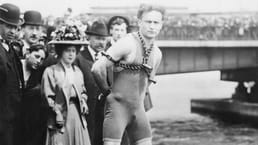
In February 1918, the New York Hippodrome set aside a room where Harry Houdini taught men in uniform to free themselves from handcuffs, ropes and other restraints [8]. Officers booked appointments during intervals in Cheer Up, the theatre's spectacular revue, and Houdini also offered to teach servicemen how to escape from sinking ships, an offer that drew the attention of the War Department [8].
Erik Weisz was born in Budapest on March 24, 1874, and the family arrived in the United States on July 3, 1878, settling in Appleton, Wisconsin, where his father served as rabbi of a Reform congregation [2][11]. He took the name Harry Houdini from the French magician Jean-Eugène Robert-Houdin and spent the 1890s on vaudeville bills, the variety circuit whose short, unrelated acts included magic and illusions [2][1]. Theatre manager Martin Beck saw the handcuff act in St. Paul in 1899 and within months had him booked into top vaudeville houses across the country [11].
The United States joined the Allies in April 1917, after Germany resumed unrestricted submarine warfare against Atlantic shipping [3]. One day after the declaration of war, Houdini introduced a resolution at the Society of American Magicians tendering the members' loyalty to President Woodrow Wilson and their desire to render such service as lay within their province [6]. Members followed him into government work. Archie Engel became a secret agent for the Treasury Department, Charles Mendelsohn joined a cryptography department that deciphered German codes, and Maximilian Toch headed a camouflage division [6].
For more than a year Houdini travelled from training camp to training camp, teaching soldiers to escape from ropes, chains and German handcuffs and to survive on a sinking vessel [7]. His lecture on abandoning ship started with orientation. 'The reason people drown on a sinking vessel is because they lose all sense of direction,' he told the troops [6]. Modern accounts describe the instruction as an early version of the survival, evasion, resistance and escape training that the military later formalized, and note that he taught spies as well as soldiers [9].
In Handcuff Secrets, a 1910 book he wrote to discourage imitators, Houdini explained that most old-time cuffs could be opened with a shoestring, looped to lasso the end of the screw and yank the bolt back [10]. He also showed that some cuffs sprang open when banged against a hard surface, such as a lead plate fastened under his trousers at the knee [10]. Contemporary cuffs hold a wrist with a rotating arm and ratchet that will not release without a key or specialist knowledge, so the demonstrations addressed a real risk for men who might be captured [4].
At the Hippodrome on January 7, 1918, Houdini made a full-grown elephant disappear in front of an audience of more than 5,000 [6]. He wrote to the theatre's manager, R. H. Burnside, making the case for free performances there: 'My heart is in this work, for it is not a question of "Will we lose." We must win, and that is all there is to it' [6][7]. He also sold Liberty Bonds, the loans that funded the war effort [6].
Houdini built his career on handcuffs, padlocks, straitjackets, mail bags, beer barrels and prison cells, and he argued that his main escape acts were copyrighted, suing the competitor John Clempert in 1906 [5]. In 1909, while performing near Hamburg, he bought a French-built Voisin biplane and arranged with the local German commander to use the army parade ground in exchange for instructing soldiers in aviation, flying successfully at Wandsbek on November 26, 1909 [8]. Biographer Bernard Kellock recorded that Houdini later destroyed photographs of himself with those German soldiers [8]. He died in Detroit on October 31, 1926, aged 52 [2][8].