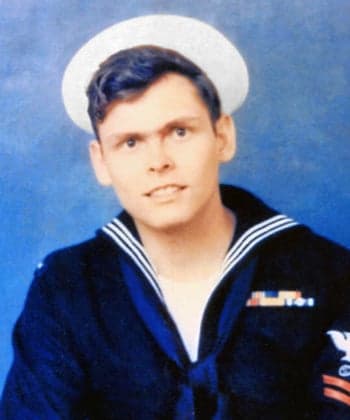
In 1998, at a reunion dinner hosted by the Nixon Library in Yorba Linda, California, Douglas Hegdahl stood up and sang more than 200 names of American prisoners of war to the tune of "Old MacDonald Had a Farm." He had been carrying that list since 1969, and by the account of the POW Network, he could still repeat the complete list that night [2][3].
The song started with a gun. Early on the morning of April 6, 1967, Hegdahl, a 20-year-old seaman apprentice from Clark, South Dakota, was aboard the cruiser USS Canberra in the Gulf of Tonkin, three miles off the coast. He had climbed up on deck to watch the ship fire, and the blast from a 5-inch gun mount knocked him overboard [1][5]. He left his glasses behind in his bunk [5].
He swam and treaded water for hours. The accounts differ on how many: several hours in one telling, five in another, about twelve in a third [1][2][6]. Vietnamese fishermen pulled him out and treated him well, then handed him to militia who clubbed him with their rifles before taking him to Hoa Lo Prison, the place the Americans called the Hanoi Hilton [1][2].
His interrogators did not believe the overboard story. They thought they had caught a commando or an agent, and they maltreated him for a few days [1]. Hegdahl decided he would be safer as a fool. He agreed to write anti-American statements but claimed he could not read or write; when the camp assigned a man to teach him, he seemed so incapable of learning that they gave up [1][6]. The Vietnamese called him "The Incredibly Stupid One" and let him move through the camp almost freely [1][6].
That freedom made him a courier. Prisoners verified a new man's identity by tapping the first five notes of "Shave and a Haircut" against a cell wall and waiting for the answer, then passed messages in tap code [1]. Working with Joseph Crecca, an Air Force officer held in the same camp, Hegdahl memorized the names, capture dates, methods of capture and personal details of about 256 men [1][6]. He also put dirt in the fuel tanks of five trucks, which had to be towed out [6], and talked his captors into a trip to Hanoi for new glasses, memorizing the route [6].
The guards handed him another opening when they tried to punish Commander Richard Stratton by making the young sailor his roommate. The two men got along at once. Stratton admired Hegdahl's common sense and courage, and together they built an intelligence network with Hegdahl carrying messages and Stratton running it [2].
The prisoners held to a rule: all released or none. In early August 1969, they decided the story of their torture had to reach Washington, and that an early release would also deliver a fuller list of the men still held [2][3]. Hegdahl, Bob Frishman and Wesley Rumble were let go as a propaganda gesture, but only Hegdahl left with the others' approval [3]. Stratton told him to go ahead and blow the whistle, even if it meant more torture for those left behind [3]. His senior ranking officer ordered him to take it and report to the State Department [4].
He was released on August 5, 1969 [4][6]. Early releasees have carried a stigma for leaving before the rest, but the POW Network records that Hegdahl is welcomed among the returnees [3]. He later confronted the North Vietnamese about their treatment of prisoners at the Paris Peace Talks, and he is the only POW to have accepted early release under honorable conditions, by order of his superiors [4].
The tune was a mnemonic, a way to keep 256 men in order in his head. At Yorba Linda he ran through more than 200 of the names aloud, three decades after he had left Hanoi [2][3].