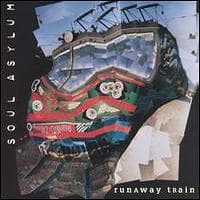
Columbia Records released "Runaway Train" in May 1993 as the third single from Grave Dancers Union, the Soul Asylum album that had arrived the previous year [1][5]. The acoustic ballad, written by singer Dave Pirner and produced by Michael Beinhorn, climbed to number five on the Billboard Hot 100 and later won the Grammy for Best Rock Song [1][2]. Pirner has said the lyrics grew out of a period of depression he likened to a train running out of control [1][8].
Director Tony Kaye built the accompanying video around a roadside poster of a missing child [8]. Between shots of the band playing in a derelict farmhouse, the video ran dramatized scenes of children in danger alongside photographs and names of real missing young people, most of them children and teenagers [1][9]. The photographs came from the National Center for Missing & Exploited Children, the nonprofit Congress established in 1984 and opened by President Ronald Reagan at a White House ceremony that June [3][9].
Kaye cut three American versions of the video, each with a different set of faces, so that 36 missing children appeared across the run [8][9]. The first version premiered on MTV in May 1993, and the network often appended a closing card urging viewers who recognized anyone to call [8]. The clip drew heavy airplay on MTV and VH1 that summer, and the network taped interviews with the band for its September 2 Video Music Awards pre-show [1][7].
On August 10, 1993, the Associated Press reported that a 16-year-old girl who had left home two years earlier with her boyfriend saw her own photograph on MTV and called her mother [9]. She went back to Arkansas, where she began studying for a GED [9]. The president of NCMEC told the AP that five other children from the video had reestablished contact with their families [9].
In a 2022 interview with The Guardian, Kaye said that of the 36 children in the American versions, "we eventually found 21" [9]. Publicity for NCMEC's 2019 revival of the video asserted the same figure, and Grammy.com reported that the video had helped recover 21 missing children [9][10].
Nick Keppler, writing for Slate in August 2023, tracked down the children themselves and came back with a different accounting [9]. Eleven of the young people shown in the videos were still missing three decades later, among them Christopher Kerze, a 17-year-old from Eagan, Minnesota, last seen on April 20, 1990, whose abandoned family van turned up two days later near Grand Rapids [6][8][9].
NCMEC handles cases involving minors from infancy through age 20, and its files hold children who ran away as well as children taken by relatives or by strangers [3]. Parental abduction is by far the most common form of child abduction; researchers counted roughly 200,000 such cases in 2010 alone, and most of those children were gone less than a week [4].
In 2019, Jamie N Commons, Skylar Grey and Gallant recorded a cover for the video's 25th anniversary, and NCMEC built a site that used geo-targeting to show each viewer cases from their own area [10]. Pirner said he had wanted the original to have "impact in the real world," and he welcomed the remake for reaching an audience that watches on phones rather than television [10][11].
Sources
- Wikipedia: Runaway Train (Soul Asylum song)
- Wikipedia: Soul Asylum
- Wikipedia: National Center for Missing & Exploited Children
- Wikipedia: Child abduction
- Wikipedia: Soul Asylum discography
- Wikipedia: Disappearance of Christopher Kerze
- Wikipedia: 1993 MTV Video Music Awards
- allthatsinteresting.com
- slate.com
- grammy.com
- en.wikipedia.org