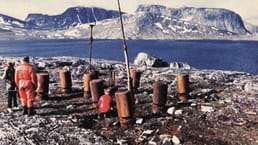
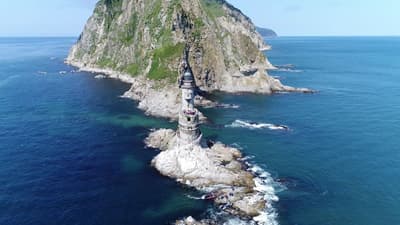
The Soviets built a chain of remote lighthouses along the Arctic coast, each powered by its own miniature nuclear generator. In total, 1,007 of these units were deployed; several remain unaccounted for.
The Arctic is a place where things go to be forgotten. It is a vast, white void of permafrost, crushing ice, and a silence so heavy it feels physical. For most of human history, this coastline was a barrier—a lethal edge of the world that defied navigation and resisted settlement. But in the mid-20th century, the Soviet Union decided this void needed to be tamed. They intended to transform a frozen wasteland into a maritime highway.
The objective was the Northern Sea Route, a 5,600km maritime artery stretching from the Kara Sea to the Bering Strait. It was a geopolitical necessity: a way to connect Western Russia to its Far Eastern territories without navigating the long, treacherous routes of the southern oceans. But there was a problem, one as much about biology as geography: the Arctic is a place where humans simply cannot survive alone.
To guide ships through fog and the polar night, you need lighthouses. But a lighthouse requires a keeper, or at the very least, a power grid. In the high Arctic, there are no grids. There are no roads. Sending a rotation of workers to live in isolation, surrounded by months of darkness and temperatures that can freeze a man in his tracks, was a logistical nightmare the Soviet state was unwilling to endure.
The Solution of Terrifying Elegance
The engineers in Moscow bypassed traditional solutions. They didn't look to wind, solar, or diesel. Instead, they looked toward the atom. They decided that if they couldn't send humans to the lighthouses, they would send something that didn't need them at all: a miniature, self-sustaining nuclear heart.
This is where the science becomes both brilliant and deeply unsettling. They utilized Radioisotope Thermoelectric Generators, or RTGs. Unlike the massive, complex nuclear reactors found in power plants, an RTG is a marvel of brutal simplicity. It does not rely on a fission chain reaction; instead, it harvests the heat generated by the natural, steady decay of radioactive isotopes—most notably Strontium-90[1]. This heat is converted directly into electricity through the Seebeck effect, providing a steady, reliable trickle of power that can last for decades without a single person ever turning a wrench.
It was a solution of terrifying elegance. It solved the problem of isolation by making the machines immortal. You could drop a generator into the permafrost, bury it, and walk away. It would sit there, glowing with a quiet, radioactive heat, pulsing light into the Arctic night for twenty years or more, indifferent to the howling storms above.
A Thousand Radioactive Sentinels
The scale of the project was staggering. This was not a handful of experimental units; it was a massive, industrial-scale deployment of nuclear technology across the most inhospitable terrain on Earth. In total, the Soviet Union installed approximately 1,007 of these RTGs along the Arctic coast[2]. They were the silent sentinels of the Northern Sea Route, scattered like breadcrumbs across a frozen desert.
For a time, the system worked perfectly. The lighthouses blinked on, the ships passed safely, and the Soviet Union projected an image of absolute mastery over the elements. The Arctic was no longer a barrier; it was a managed corridor. But the machines had a fundamental flaw that had nothing to do with physics and everything to do with politics: they required a state that could afford to maintain them.
The Ghost Lights of the Collapse
When the Soviet Union collapsed in 1991, the empire didn't just shrink; it fractured. The massive funding required to monitor, maintain, and eventually decommission these nuclear installations evaporated overnight. The centralized authority that had placed these "atomic hearts" in the ice vanished, leaving the machines to fend for themselves.
As the years passed, the lighthouses began to fail. Some were swallowed by shifting permafrost; others were simply abandoned as the shipping routes they were meant to protect became less economically viable. But the real danger wasn't just that the lights went out. It was that the power sources remained.
Today, the Arctic is littered with the ghosts of the Soviet era. Many of these RTGs are unaccounted for. They are "lost" in the sense that their exact locations are no longer documented with precision, or they have been displaced by the chaotic movements of the earth itself. This has created a silent, invisible crisis. There are fears of "dirty bomb" scavengers—individuals looking to harvest Strontium-90 for illicit use—and the very real possibility of radioactive leakage as aging protective casings succumb to the extreme freeze-thaw cycles of the Arctic climate[3].
We are left with a haunting legacy: a thousand tiny suns, buried in the ice, waiting to be found—or to be forgotten forever.
Sources
- Historical overview of Radioisotope Thermoelectric Generators (RTGs) and Strontium-90 decay properties.
- Data regarding Soviet Arctic maritime infrastructure and the Northern Sea Route development.
- Environmental reports on the decommissioning challenges of abandoned Soviet nuclear assets.