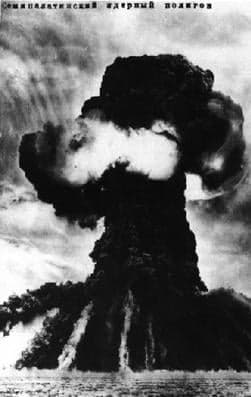
On January 15, 1965, a 140-kiloton thermonuclear device sat beneath the dry bed of the Chagan River, near the edge of the Semipalatinsk Test Site in what is now Kazakhstan.[1] It had been placed in a shaft about 178 meters deep so the blast would throw up a crater rim that could catch the river’s spring flow like a dam.[2]
Lake Chagan, also called Atom-Kol or the “Atomic Lake,” was made by a Soviet nuclear blast meant to create a reservoir. The crater filled with water, but the test also left radioactive contamination around the site.
The Soviet Union filed the project under a startlingly ordinary name: Nuclear Explosions for the National Economy. Chagan was the first and largest of 124 detonations in that program, which explored “peaceful nuclear explosions” for earth-moving projects such as lakes, canals, harbors, and reservoirs.[1]
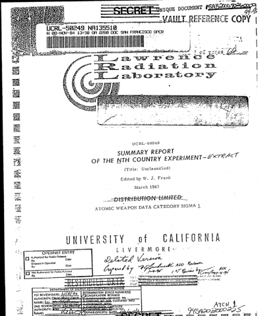
The idea was not uniquely Soviet. In July 1962, the United States had carried out the Sedan shallow cratering test at the Nevada Test Site as part of Project Plowshare, its own program for peaceful nuclear explosions.[1] Chagan was later described as a near clone of Sedan, but larger: 140 kilotons of TNT compared with Sedan’s 104 kilotons.[1]
The chosen site was practical in the bluntest possible way. The dry Chagan riverbed lay where a conical crater could be blasted into the ground, with the raised lip positioned to block the river during high flow.[1] After the detonation, a channel was cut so water could enter the crater and form a reservoir behind it.[2]
The lake did appear. One source gives the crater a diameter of 408 meters and a depth of 100 meters.[1] Lake data for Shagan describe the nuclear pothole as roughly 0.45 kilometers long and 0.38 kilometers wide, with a maximum depth around 100 meters and a volume of 0.0191 cubic kilometers, or about 19.1 million cubic meters.[3] Older versions of the fact often circulate with the rounder figure of about 10 million cubic meters.
The Blast That Did Not Stay Local
Open cratering explosions carried their own contradiction. They were underground, but not sealed. Tests like Sedan and Chagan released steam, pulverized rock, and radioactive material, including an estimated 20 percent of the device’s fission products, into the atmosphere.[1]
Most of Chagan’s fallout landed near the test area, but not all of it. A small measurable radioactive plume was detected over Japan, prompting an initial American complaint that the Soviet Union had violated the October 1963 Limited Test Ban Treaty.[1] That treaty banned atmospheric nuclear tests and subsurface detonations that caused radioactive debris to cross beyond the state’s territory.[1]
The device used at Chagan was a low fission-fraction design, so a smaller share of its yield came from fission than in many military nuclear devices.[1] The landscape still registered the blast. One summary reports that a few days after the test, radiation levels on the crater edge reached 200 to 300 millisieverts per hour, with cobalt-60 named as a main source.[2]
Later measurements kept the site from becoming a clean success story. A 2017 study cited by Bowdoin’s Echoes of the Steppe found soil contamination concentrated near the Atomic Lake, especially within 1 to 2 kilometers downstream from the crater ridge, at levels significantly higher than global fallout.[2]
Today the lake is known as Lake Chagan, Shagan, or Atom-Kol, from Kazakh for “Atomic Lake.”[2][3] Satellite descriptions still make the experiment easy to read from above: the round nuclear pothole, the reservoir in the floodplain of the Shagan and Ashchysu rivers, and nearby Lake Zhanan.[3] A river was turned into storage, and the water still carries a name that says how the hole was made.