When people imagine the first country to back Greek independence, they tend to picture one of the great European powers stepping forward in polished boots and diplomatic language. Britain, perhaps. France. Russia. Some empire with a navy, a treasury, and the habit of deciding who counts as a nation.
But the first independent state to recognize the Greek Revolution was Haiti.[1]
That fact lands harder when you remember what Haiti was in 1822. This was not a rich old kingdom looking for influence abroad. It was a young Black republic born from the only successful large-scale slave revolt in modern history, still scarred by war, still poor, still fighting to secure its own place in a hostile world. And yet when Greek revolutionaries reached out for help in their struggle against Ottoman rule, Haiti answered.[1]
A Revolutionary Republic Recognizes Another
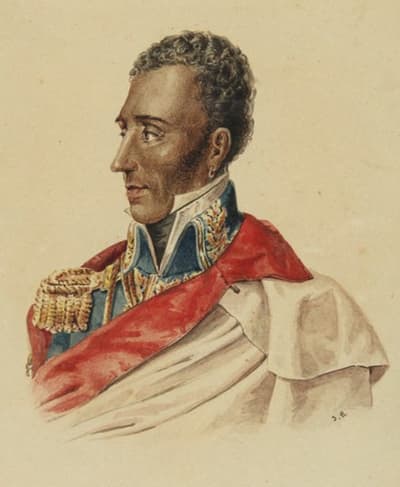
The moment centered on Jean-Pierre Boyer, president of Haiti. Following a Greek request for assistance, Boyer sent a letter dated 15 January 1822 to the Greek committee in France that had been seeking international support for the uprising.[1] Among those involved were Greek expatriates, including Adamantios Korais and others trying to convert sympathy into something more durable than applause.
Boyer's reply was not just a diplomatic note. It was something more intimate than that. He compared the Greek struggle with Haiti's own fight for freedom across the Atlantic.[1] Haiti did not need the revolution explained to it. Haiti had already lived the experience of being ruled, exploited, dismissed, and then forced to prove, at enormous cost, that liberty was not a theory but a battlefield fact.
That is what makes Haiti's recognition so striking. It was not the language of an empire managing instability. It was the language of one revolution recognizing another.
The Problem With Solidarity Is Poverty
There was, however, a brutal complication. Haiti sympathized, but Haiti was poor. Boyer reportedly apologized for being unable to support the Greek cause financially, explaining that Haitians themselves had been left destitute by their own long war for independence.[1]
That detail matters because it changes the emotional geometry of the story. This was not a powerful state giving from abundance. It was a fragile one giving from memory. Haiti understood the appeal because it had already paid the price of freedom in blood, debt, destruction, and diplomatic isolation. Its support came not from comfort, but from recognition.
And then comes the part of the story people remember best, because it sounds almost too symbolic to improve on.
The Coffee Shipment
According to the account attached to this episode, Haiti sent 25 tons of coffee beans so they could be sold to help finance the Greek rebellion.[1] Whether later retellings have polished the story into something neater than history usually is, the image has endured for a reason. It captures a small republic trying to give what it actually had.
Not warships. Not loans. Not a formal guarantee backed by force. Coffee.
There is something almost perfect about that. Coffee is ordinary, commercial, portable, practical. It is not the sort of thing schoolbooks train you to expect in stories about independence movements. But that is precisely why it stays with you. A struggling post-revolutionary state, unable to send cash, sends cargo that might become cash. Sympathy converted into sacks, weight, and trade.
Even if the coffee story has acquired a slightly legendary sheen over time, the underlying truth remains: Haiti's support was meant to be material as well as moral. It was an attempt, however modest, to turn recognition into assistance.[1]
Why Haiti Moved First
The larger Western powers were slower, more calculating, more entangled. For them, Greek independence was a matter of balance, influence, and imperial arithmetic. For Haiti, the shape of the question looked simpler. What does it mean when a people rise against an empire and ask to be seen as free? Haiti knew the answer because Haiti had already forced the world to confront it.
That may be why Haiti could move with a kind of clarity others lacked. It had fewer illusions about how independence works. Independence is rarely bestowed when the powerful decide the timing is elegant. More often, it is seized, defended, and only later acknowledged.
So Haiti's gesture was larger than protocol. It was one anti-colonial project saluting another. A nation that had fought its way into existence looked across the ocean and recognized the outline of its own past in somebody else's present.
The Countries History Likes to Forget
This is also the kind of episode world history has a habit of flattening. Recognition is usually remembered as something bestowed by great powers, as if legitimacy only becomes real once it passes through the hands of empires. Smaller states, especially poor Black republics in the 19th century, are often pushed to the margins even when they act first.
But first matters. It matters who sees a struggle before it becomes fashionable. It matters who responds before support is safe. Haiti did not have prestige on its side. It had something rarer: experience.
And that experience made its recognition of the Greek Revolution feel less like ceremony and more like solidarity. Not abstract admiration. Not a distant endorsement. Something closer to: we know what this costs.
That is why the story deserves to be remembered in full. Not just because Haiti got there before the Western powers did, though it did.[1] Not just because of the famous coffee, though that is the detail people carry away. It matters because it reminds us that the first nation to say, in effect, your fight is real, was not an empire at all. It was a vulnerable republic that knew exactly what freedom costs.
Sources
[1] Wikipedia - Jean-Pierre Boyer, Greek War of Independence section