
If you tried to build the Solar System honestly, you would run into the same problem everyone runs into eventually: space is mostly emptiness. Textbooks flatten that emptiness. Posters cheat it. Planetarium models imply the planets live in some cozy arrangement, like ornaments hung a polite distance apart.
Sweden does something more unsettling. It makes you travel for it.
In the Sweden Solar System, the Sun is not a classroom lamp or a painted sphere. It is Stockholm’s Globe Arena, now known as Avicii Arena, a building so large and so round that it can plausibly stand in for the thing everything else depends on.[1][2] From there, the rest of the Solar System does not gather neatly around it. It disperses across the country.
That is the trick that makes the whole project memorable. At a scale of 1:20 million, one meter equals 20,000 kilometers in space.[1][2] Suddenly the inner planets fit into greater Stockholm, while the outer planets drift outward into airports, university towns, coastal cities, and small communities farther north. The model stops being an object and becomes a geography lesson in cosmic proportions.
The Sun Is A Building, Which Is Exactly The Right Kind Of Absurd
The choice of the Globe is not incidental. It is the largest spherical building in the world, which gives the model an immediate sense of physical credibility.[1][2] If you are going to represent the Sun at this scale, you need something monumental. Not symbolic. Monumental.
And that turns out to be the deeper genius of the project. Most scale models shrink the universe until it becomes manageable. The Sweden Solar System does almost the opposite. It preserves the vastness just enough to make you feel how unreasonable the real thing is. The planets are not merely small. They are small and far away. Those are two different kinds of insignificance, and this model lets you feel both.
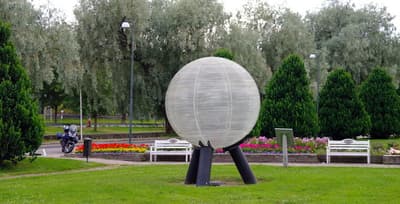
Mercury, Venus, Earth, and Mars remain in or near Stockholm, which feels comforting at first.[2] There they are, the familiar inner family, still close enough to imagine as neighbors. But then Jupiter appears out by Arlanda Airport, Saturn is placed in Uppsala, Neptune is in Söderhamn, and Pluto ends up in Delsbo, roughly 300 kilometers from the Globe.[1][2] The Solar System begins to behave less like a diagram and more like weather. It spreads.
The Outer Planets Restore The Part Textbooks Remove
That spread is the point. The real Solar System is not chiefly a collection of planets. It is a collection of distances. We tend to remember the names and forget the void between them. Sweden’s model restores the void.
Jupiter, for example, is enormous in the model, about 7.3 meters across, yet even that giant sits 40 kilometers from the Sun.[2] Saturn, still huge, is farther still. By the time you reach Uranus and Neptune, the lesson has become unavoidable: the drama of the Solar System is not just that the planets exist, but that they exist so absurdly far apart.
That is what a road trip through this model teaches better than almost any museum exhibit could. Space is not crowded. Space is lonely. If you drive from one installation to another, what you keep encountering is not just sculpture, but interval. The emptiness becomes part of the exhibit.
And then there is Pluto, sitting out in Delsbo like the end of a sentence that kept getting extended.[1][2] Even as Pluto’s formal status changed from planet to dwarf planet, it remained culturally indispensable, which somehow makes its placement even better. It is distant, diminished, still beloved, and still very much there.
A Model Of Astronomy, But Also Of Human Culture
The Sweden Solar System works because it is not merely scientific. It is also mythological, artistic, and civic by design. Each station has a host institution, and the installations are meant to connect astronomy with local place, public art, and the old stories behind the planetary names.[1] That matters more than it first appears to.
A sterile model would have made the Solar System clearer. This one makes it stick.
The planets come wrapped in inherited stories, and Sweden leans into that. The project does not pretend science arrives stripped of culture. It acknowledges that we understand the sky through metaphor, naming, architecture, and pilgrimage as much as through measurement.
That is why the model has grown beyond the classical planets. It includes dwarf planets, asteroids, comets, and even abstract outer boundaries, turning the country into an evolving map of what humanity currently thinks the Solar System is.[2] That is a quietly elegant choice. The model is not a frozen monument to what people once knew. It can expand as knowledge expands.
The Real Subject Is Scale
There is a reason people remember this project once they hear about it. It takes a concept everyone claims to understand, scale, and reveals that most of us do not understand it at all.
We say the planets orbit the Sun, and the sentence feels complete. But it leaves out the physical truth of the thing. Earth is tiny next to the Sun. Jupiter is huge next to Earth. And yet the deeper surprise is that all of them are suspended across distances so large that a whole nation can become a teaching tool.
The Sweden Solar System is often described as the world’s largest scale model of the Solar System, and that is true in the obvious sense.[1][2] But what makes it remarkable is not merely size. It is its fidelity to inconvenience. To understand this model, you cannot stand in one spot. You have to move. You have to commute through the lesson.
That makes it unusually honest. Astronomy is full of numbers so large they become decorative. This project drags those numbers back into the body. You feel them in travel time, in maps, and in the strange realization that what looked clustered in a textbook is actually scattered across Sweden.
Why It Endures
Plenty of public science installations explain facts. Very few alter your intuition. The Sweden Solar System does. Once you understand it, the Solar System no longer feels compact. It feels properly extravagant.
And perhaps that is why the model has lasted. It is pedagogical, yes, but it is also theatrical in the best way. It uses a giant spherical arena as the Sun, sends the planets north through the country, and lets scale itself deliver the punchline.[1][2] You begin with a clever idea and end with a harder truth: our planetary neighborhood is mostly distance, and distance is the story.
That is what the Sweden Solar System makes visible. Not just where the planets are, but how much nothing has to exist between them for a solar system to be a solar system at all.