By 2006 the Snapeists were most active on LiveJournal, where a small group of women built a religious movement around Severus Snape [7]. The community never numbered more than a handful of individuals, and three members were the best documented [5]. Most adherents were middle-aged women who also gathered on other online forums [5]. Other Harry Potter readers treated the group as extreme and delusional, and the ridicule eventually drove the community to delete its pages [5][7].
The first Harry Potter novel appeared in 1997, with Severus Snape installed as Potions professor at Hogwarts School of Witchcraft and Wizardry [1][6]. He dies at Lord Voldemort's hands in the seventh book, when his years as a double agent for Albus Dumbledore are revealed [1]. Alan Rickman played him in all eight films released between 2001 and 2011 [1]. Commentators have linked the movement's imagery to Rickman's screen performance of the role [5].
Snapeist teaching held that Snape exists as a spiritual being independent of the novels, an omniscient and omnipresent deity able to interact with his believers [5]. Members addressed him as "Master" and compared his presence to that of the Christian God [6][7]. They also held that J. K. Rowling wrote the books because Snape was channeling through her, and that she had misrepresented him by giving him a miserable life and an antihero's death [5][6]. That premise allowed them to set aside passages of canon they rejected, on the reasoning that Rowling was not Snape [7].
Members practiced channeling, and one of them, Tonya, was considered the most skilled at it and used that standing to issue new rules for the group [6]. A statement attributed to Snape through her read: "I only give audience to those women that are strong and able to withstand my fierce temper and do as I say" [6]. The movement produced vows, sacraments, prayers, and theology, and its followers took all of it seriously [7].
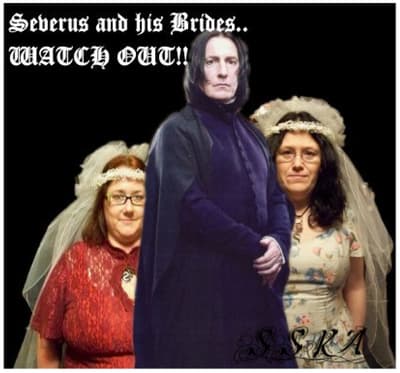
Members described their bond with Snape as a marriage and professed romantic, sexual, and emotional love for him [5]. Some had husbands, and those marriages were treated as secondary; a husband could even serve as another vessel for channeling Snape [6]. The community also discussed astral projection [7], a practice that occult and New Age writers describe as separating consciousness from the physical body through meditation, lucid dreaming, or hypnosis [3].
The Snapeists organized on LiveJournal and various online forums rather than in any physical building [5]. Online religion of this kind had been growing for years: in the United States the share of churches with websites rose from 11 percent to 45 percent between 1998 and 2002, and the i-church became the first internet community recognised as an Anglican church [4]. Harry Potter fandom more broadly ran on fan fiction, fan art, role-playing games, and forums, with fan sites dating to 1997 and 1998 [2].
Zoe Alderton published a study of the group in the journal Religions on 3 March 2014 under the title "'Snapewives' and 'Snapeism': A Fiction-Based Religion within the Harry Potter Fandom" [5]. She treated the movement as a fiction-based faith and argued that it was neither unique nor insane [7]. Later writing has cited the Snapeists as evidence in arguments about modern religious belief, misogyny toward female fans, the overlap of religion and fandom, and the difficulty of defining religion at all [5].
Interest in other male fictional characters eventually broke the group apart, since Snapeism demanded exclusive devotion [6]. The forums and webpages were deleted, and copies of the material circulated on fandom_wank for outsiders to mock [7]. A 2024 essay described the group's rules as rooted in misogyny and elitism, with members ranking themselves above ordinary fans [6].