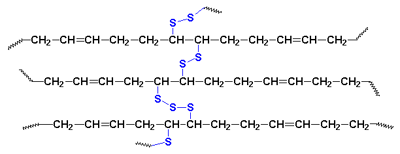
In 1838 the American inventor Charles Goodyear found that adding a small amount of sulfur improved natural rubber's elastic properties [2]. Another account places the discovery in the winter of 1839 in Massachusetts, where Goodyear spilled a mixture of rubber latex and sulfur on a hot stovetop [1]. The heated mixture produced a rubbery solid that stayed flexible in the cold Massachusetts winter and did not become gooey when warmed again [1]. The process became known as vulcanization [1].
A sulfur molecule used in vulcanization contains eight sulfur atoms arranged in a ring [1]. When those rings are heated with polyisoprene molecules, the rings open and fragments join with the polymer chains [1]. At about 150 °C, reactive cross-linker molecules such as sulfur decompose and subsequent reactions form chemical bonds between adjacent chains [2]. In rubber, sulfur acts as the cross-linking agent [3].
Each cross-link in natural rubber produces a network node with four chains emanating from it [2][3]. Because each rubber polymer is very long, one polymer participates in many cross-links with many other polymers, forming a continuous network [2]. All the polyisoprene molecules become connected at multiple points, producing a single giant molecule [2]. A rubber band and a latex glove are each described as a single molecule [2].
Cross-linked rubber can stretch to about ten times its original length and return close to that length when released, and it can repeat this many times with no apparent degradation [2]. Cross-linking makes rubber stronger and helps it keep its shape when stretched repeatedly [1]. It also keeps rubber from becoming gooey in hot climates because a single molecule cannot flow like a substance made of many molecules [1]. Cross-link density controls these effects: low densities increase viscosity, intermediate densities give elastomeric properties, and very high densities make materials rigid or glassy [3].
More than 1 billion tires are manufactured worldwide each year in about 455 factories [4]. Tire factories assemble components on a drum and cure the tire in a press under heat and pressure, and heat facilitates a polymerization reaction that crosslinks rubber to create long elastic molecules [4]. Cross-linking also creates a recycling problem. Because cross-linked rubber does not flow when hot, it must be molded into shape before cross-linking [1]. In most cases cross-linking is irreversible, and the resulting thermosetting material will degrade or burn if heated without melting, so car tires cannot be recycled easily [3].
Several experimental processes are being investigated for recycling cross-linked rubber [1]. Thermoplastic elastomers offer another route because they rely on physical cross-links in their microstructure [3]. Those physical cross-links are weaker interactions, and the domains that act as cross-links are reversible and can be reformed by heat [3]. Thermoplastic elastomers are used in non-tire applications such as snowmobile tracks and catheters for medical use [3].
Tire manufacturing still depends on natural rubber, or polyisoprene, as a basic elastomer, and synthetic rubbers such as styrene-butadiene copolymer are often substituted in part based on raw material cost [4]. The cured tire is an assembly of components including an inner liner, body ply, sidewall, beads, belt package, and tread [4]. Each component uses rubber compounds chosen for properties such as air retention, strength, abrasion resistance, or traction [4]. The cross-linked network remains central to the tire's elastic behavior and to the difficulty of recycling it [2][3][4].